
USA Health Magazine: A weight lifted
Emergency care team provides calm and comfort during crisis.
By Lindsay Hughes
[email protected]
This story was originally featured in the Fall 2025 edition of the USA Health magazine.
Doctor appointments, dental cleanings and emergency visits can be scary for 9-year-old Beau Wallace. Nonverbal and on the autism spectrum, Beau is a happy, loving boy who experiences the world differently.

“I call him my gentle giant,” his mother, Sarah Wallace, said. “He’s big for his age. He’s a really special kid who is very sweet and brings a lot of love to the world. He just can’t verbalize it. He has to show it. He will smother you to death with hugs and kisses.”
With a head full of curly brown hair, hazel-green eyes, and a sweet smile, Beau communicates using a tablet and some sign language.
At his home in midtown Mobile, he enjoys jumping on the trampoline, playing with slime, and all things Mickey Mouse. In place of traditional school, Beau attends The CORE Project, which provides year-round education and therapy services.
Family-centered care
Over the past year, Beau has visited the Pediatric Emergency Center at USA Health Children’s & Women’s Hospital three times — once for a broken ankle, once for severe abdominal discomfort, and most recently for a painful ear infection that wasn’t responding to antibiotics.
Each visit came with its own set of challenges. For Beau, medical settings can be overwhelming — from the bright lights and crowded waiting rooms to unfamiliar faces and long wait times.
“Sometimes we have to walk outside to help him calm back down,” Wallace said. Pediatric emergency physician Reshvinder Dhillon, M.D., said the team in the emergency department is united in its goal of meeting each child where they are. The best way to avoid unnecessary stress or escalation, he noted, is by practicing patience and staying flexible.
“It’s always a priority for us in the ED to make sure children like Beau feel as comfortable and safe as possible, especially in what can be an overwhelming environment,” Dhillon said. “With kids who are neurodivergent, I always start by asking parents how their child prefers to be approached — whether they like to be touched or need extra space, how they communicate best, and what helps soothe them. Parents know their children better than anyone, and their guidance makes all the difference.”
When Beau broke his ankle, he needed X-rays, but staying still was difficult. “He didn’t understand what was going on,” Wallace recalled, “and he got really combative.”
Lauryn Jemison, a radiology technician in the pediatric emergency department, was part of the care team that day.
“For patients like Beau,” Jemison said, “we always try to create a calm and predictable environment. We try to slow things down and explain what’s going to happen in a way they can understand. That might look like dimming the lights, speaking in a quieter tone, or keeping surroundings as calm as possible. Our main goal is always to make sure they feel seen, supported, and not alone.”
That kind of compassion and attentiveness made each visit a little easier, even when the circumstances were uncertain. For example, during a visit for abdominal pain, Beau couldn’t explain what hurt.
“When something’s wrong, we see it in his behaviors — more anxiety, sometimes more aggression,” his mom said. “We were worried it might be an impaction. He was really uncomfortable.”
As the family sat in the waiting room, the usual tension began to rise.
Jennifer Bisaga from the hospital’s Mapp Child and Family Life Program approached with a simple question: “What can we do to make you more comfortable?”
Bisaga, a Certified Child Life Specialist and Certified Advanced Autism Specialist, first met Beau during triage and helped the team take initial vital signs in a way that worked best for him. That meant using a finger clip pulse oximeter instead of an adhesive one, and taking his temperature with a forehead thermometer — the type with which he was most familiar.
“I try to meet families in the early stages of their emergency visit to establish trust, make the environment sensory-friendly, explain next steps, and assist with consistent care plans to support their specific needs,” Bisaga said. “Beau is most comfortable in our chairs versus the hospital bed. We let him choose his comfortable spot in the room and make sure he has things he likes during his visits. I bring in sensory furniture from our sensory room to help him feel supported and safe when any procedures occur.”
During Beau’s third emergency visit — this time for severe ear pain — the care team knew exactly what he needed.
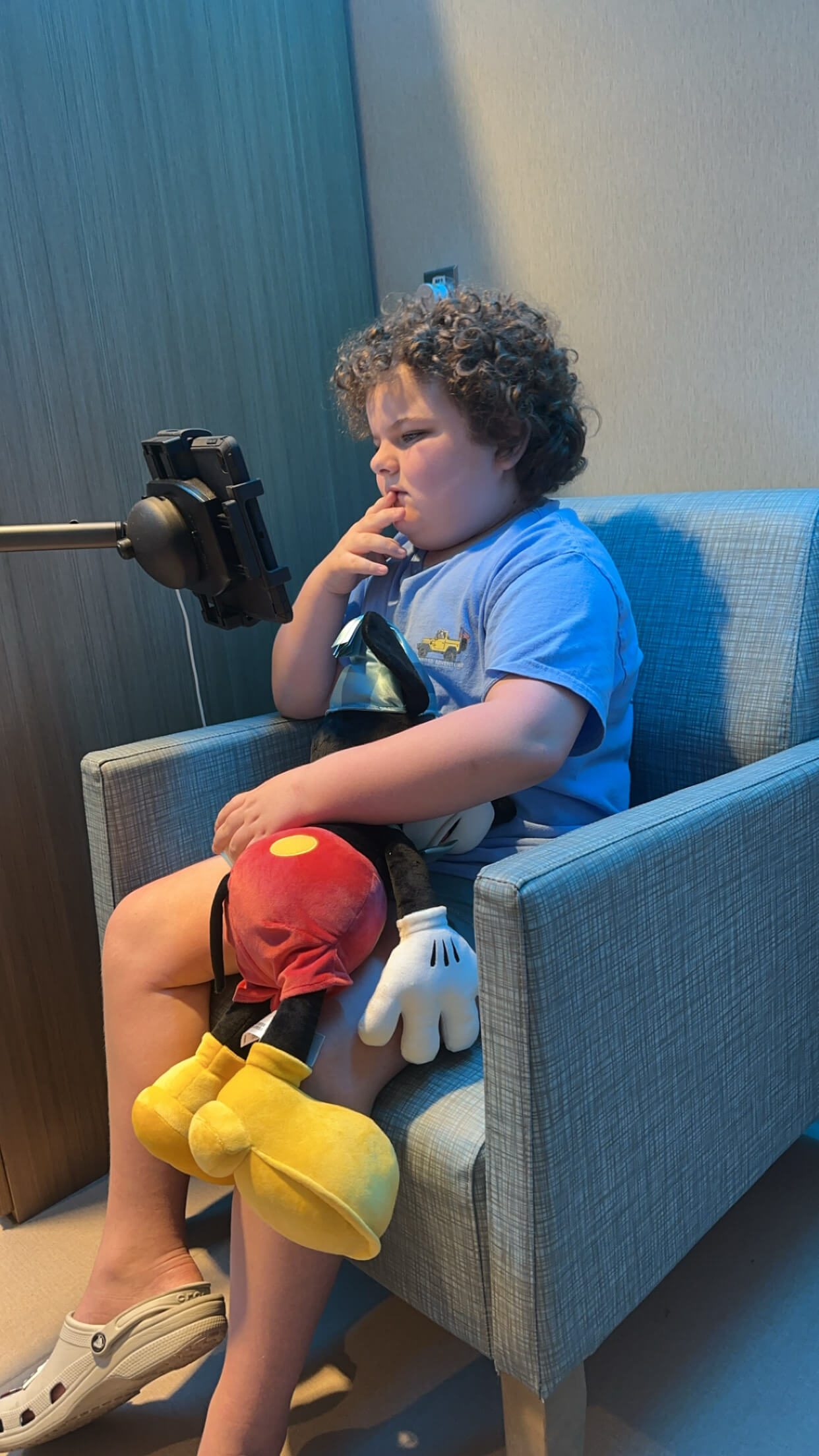
“One of my favorite moments during Beau’s visits with us was being able to provide him with a large stuffed Mickey Mouse to have as a comfort item,” Bisaga said. “Beau is one of Mickey’s biggest fans, and he held onto him throughout that entire visit.”
In a Facebook post dated Sept. 26, 2024, Wallace recounted the experience: “I can’t say enough good things about our pediatrician’s office and USA Health Children’s & Women’s Hospital emergency room staff. We have been there way more often lately than I would like, and they are always so kind and accommodating. The ER staff remembered us from last time and got all the things just the way it makes him comfortable. Today they threw in an iPad with all his favorite Mickey episodes and a stuffed Mickey for snuggles. When your child is sensitive to certain surroundings, it means everything.”
Feeling seen and supported
At the Pediatric Emergency Center, board-certified pediatric emergency medicine specialists and pediatric nursing staff work together to provide the highest level of care for patients and their families.
“Beau’s story is a wonderful testament to the importance of combining medical care with other supportive services,” Bisaga said. “Child Life is an extra layer of support that can help children have an experience that is truly aligned with their developmental, social, emotional, and sensory needs.”
Jemison added, “It truly makes my heart happy to hear when our sweet patients and families have a great experience. I try to cherish each interaction with my patients and take pride in making it the best I possibly can.”
As a parent navigating autism in Mobile, Wallace knows how difficult it can be to find resources, especially in a crisis. “There are resources here, but there are a lot of wait lists, and sometimes you just don’t know what’s available,” she said. “There’s no manual when you get that diagnosis. You’re just trying to figure everything out.”
For Wallace, having access to a hospital equipped with staff specially trained to meet Beau’s needs makes all the difference.
“It’s already a stressor having to bring your child to a place where, in your mind, you already know it is going to be a fight,” she said. “But to walk into a place where they say, ‘Hey, we see you. We want to make your baby feel comfortable’ — that is a weight lifted.”