Pathology faculty, residents present research at AACR
The annual meeting of the American Association for Cancer Research, held April 17-22 in San Diego, is one of the largest conferences focused on cancer research, bringing together scientists, clinicians, and industry professionals.
By Carol McPhail
[email protected]
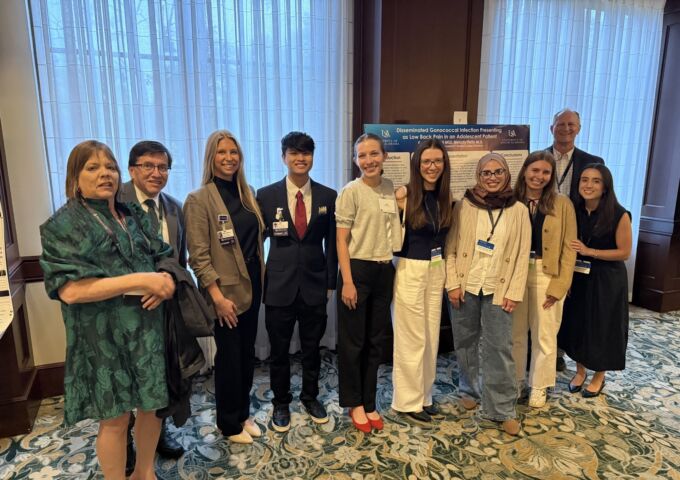
Researchers in the Department of Pathology at the Frederick P. Whiddon College of Medicine recently presented findings at the annual meeting of the American Association for Cancer Research.
The conference, held April 17-22 in San Diego, is one of the largest conferences focused on cancer research, bringing together scientists, clinicians, and industry professionals.
The poster presentations showcased research on breast cancer and colorectal cancer conducted at the Department of Pathology and USA Health Mitchell Cancer Institute, part of the academic health system for the University of South Alabama.
“Their contributions reflect the high level of scholarship and clinical rigor within our department and institution,” said Guillermo Herrera, M.D., who recently retired as professor and chair of the Department of Pathology. “Their achievements continue to strengthen USA Health’s commitment to excellence in patient care, discovery, and medical education.”
Debanjan Chakroborty, Ph.D., assistant professor of pathology, presented “Structural Heterogeneity of Tumor Spheroids Using Quantitative Assessment of Autofluorescence.” The study aimed to address the shortfall of procedures such as traditional sampling and bulk sequencing in capturing the landscape within a tumor. It identified a novel analytical workflow employing quantitative 3D autofluorescence imaging to analyze the architecture and cellular arrangement of breast cancer cell spheroids composed of breast cancer cells and fibroblasts, the main cell type of connective tissue.
“These insights can inspire future studies to explore changes within the tumor microenvironment and design new strategies targeting treatment-resistant niches in solid tumors,” the authors wrote.
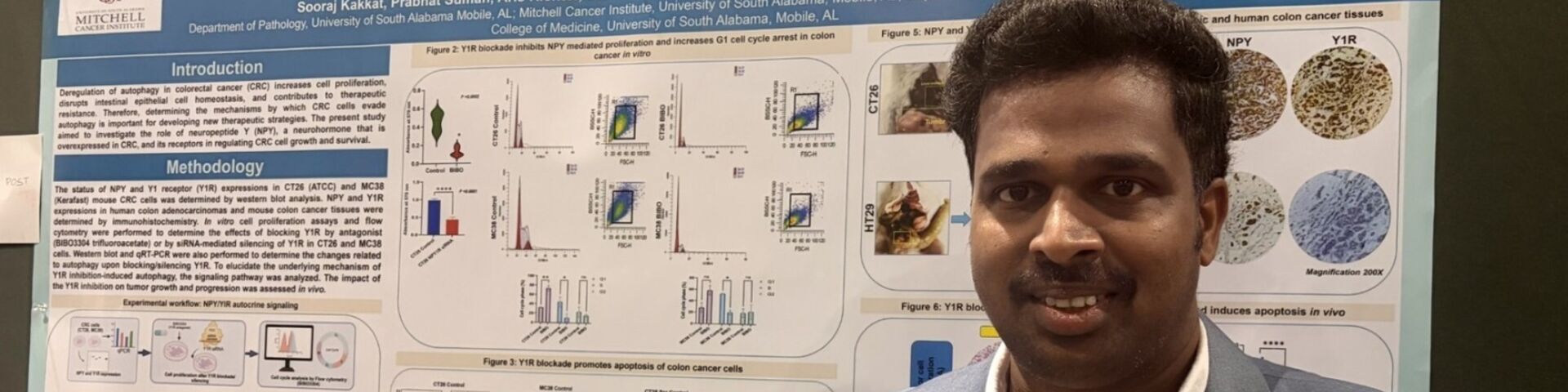
Sooraj Kakkat, Ph.D., a postdoctoral fellow, presented “Neuropeptide Y Y1 Receptor Inhibition Induces Autophagy to Limit Colorectal Cancer Progression.” The study aimed to determine the mechanisms by which colorectal cancer cells evade autophagy, the body’s cellular recycling system, which can make them more resistant to cancer therapies.
Specifically, the research explored the function of neuropeptide Y, a neurohormone that is overexpressed in colorectal cancers, and its Y1 receptor in regulating tumor cell growth and survival. It demonstrated that inhibiting the neuropeptide Y and Y1 receptor axis induces autophagy in colorectal cancer cells.
Maha Babker, M.D., a second-year pathology resident at USA Health, presented “Integrating Clinical and Multiomics Data to Characterize Ethnic Disparities in Breast Cancer on the Gulf Coast.”
The research analyzed the ethnic disparity in breast cancer among non-Hispanic Black women who received care at USA Health. The study included the analysis of gene and protein expression profiles, or multiomics, of breast cancer tumors with a system recently developed by NanoString Co.
“We observed significant differences in molecular subtype distribution and younger age at diagnosis in Black women,” the authors wrote. “Multiomics analysis further supports distinct biological tumor profiles, highlighting age-dependent mechanisms that may inform risk stratification and treatment strategies.”
“Participating in the AACR was exciting and motivating,” Babker said. “Presenting our research allowed us to contribute to the ongoing discussions about inequalities in breast cancer care and highlighted the importance of collaborative and translational research in improving patient outcomes. Attending the AACR was a valuable educational experience that exposed residents to cutting-edge cancer research and emphasized the important role pathology plays in advancing precision medicine and addressing healthcare inequalities.”
Huseyin Kilic, M.D., a second-year pathology resident at USA Health, presented “Characterization of PERK-positive Polyploid-like Breast Cancer Cells and Their Association with Unfolded Protein Response Signatures.”
The research studied breast cancer and found a small subset of tumor cells with very strong phospho-PERK staining, some showing polyploid-like features. The study found that tumors enriched with these cells were linked to stress adaptation, faster growth, metabolic changes, and more aggressive behavior, suggesting this may represent an important tumor cell state with potential clinical significance.
The research presented by Babker and Kilic was led by Luis del Pozo-Yauner, M.D., Ph.D., associate professor of pathology, and funded by the Breast Cancer Research Foundation of Alabama.
These investigations also benefited from the contributions of current and former members of the Department of Pathology, including Hector Chavarria-Bernal, M.D., assistant professor; Bahaaeldin Youssef, M.D., assistant professor; Ateeqa Mujeeb Ullah, M.D., assistant professor; Rosetta Campbell, M.D., a fourth-year pathology resident; Elba Turbat-Herrera, M.D., professor; and Guillermo A. Herrera, M.D., retired professor and department chair.
External collaborators include Veronica Ramirez-Alcantara, Ph.D., USA Health BioBank Core Facility; Wei Yang, Ph.D., Bruker Spatial Biology in Seattle; Julio I. Perez-Carreon, Ph.D., National Institute of Genomic Medicine in Mexico City; and Ajay Pratap Singh, Ph.D., University of Mississippi Medical Center in Jackson, Mississippi.