
USA Health Magazine: A different kind of encore
One musician’s fight against a rare cancer.
By Jessica Jones
This story was originally featured in the Summer 2026 edition of the USA Health magazine.
For more than four decades, music was Gregory Brown’s voice.
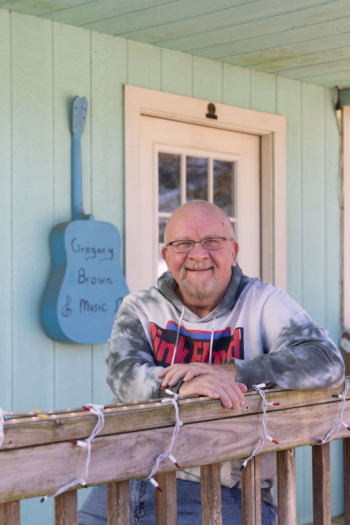
A guitarist, singer and songwriter who has performed across the Gulf Coast for decades, Brown built his life around music, often playing six to 10 shows a week at beachside restaurants and small venues from Mobile to Florida. Music wasn’t just something he loved; it was how he made a living.
During the summer of 2023, Brown’s life changed.
After long runs of performances, Brown noticed his throat getting sore and felt a small lump forming in his neck. At first, he ignored it.
Then one night after a performance, his voice disappeared. “I woke up the next morning, and it was just gone,” Brown said.
His primary care provider referred him for testing. A biopsy confirmed cancer, and Brown was soon sent to Spencer Liles, M.D., FACS, a surgical oncologist at the USA Health Mitchell Cancer Institute (MCI). By the time Liles examined Brown, the mass had grown large enough to cause difficulty swallowing and breathing and had damaged the nerve controlling his right vocal cord.
“When someone presents with vocal cord paralysis, that usually signals an advanced situation,” Liles said. “When I met Greg, it was clear this was likely an aggressive cancer."
Liles knew the tumor needed to come out quickly, and surgery offered the best path forward.
In October 2023, Liles performed a radical thyroidectomy to remove the tumor and surrounding tissue. The cancer had grown into nearby muscles and pressed against Brown’s windpipe. Liles removed the thyroid along with affected tissue and lymph nodes.
Ultimately, about 95% of the tumor was removed. A small portion had to remain because it was attached to a major artery.
Brown recovered well from surgery, but the final pathology report revealed an even greater challenge: anaplastic thyroid cancer, one of the rarest and most aggressive thyroid cancers.
“It’s very rare, roughly one to two cases per million people,” said Joseph Jones, M.D., a radiation oncologist at MCI who joined Brown’s care team soon after surgery. “If you place cancers on a spectrum from low to high risk, this one is near the very top.”
The disease often appears suddenly, with symptoms such as a rapidly enlarging neck mass, hoarseness or difficulty swallowing that can progress within a few weeks.
For Brown, hearing the diagnosis was overwhelming.
“The only thing I really understood was that people were telling me I might only have so much time to live and that this type of cancer does not respond to treatment,” he said. “My initial reaction was terror, fear. I have a wife and a big family. It was scary for all of us.”
The cancer had also permanently changed something deeply personal. The tumor had paralyzed his right vocal cord, leaving him unable to sing.
For someone who had spent more than 40 years performing professionally, that loss was profound.
"What I’ve done my whole life is sing and play,” Brown said. “When the tumor took my voice, everything changed.”
After surgery, Brown’s treatment expanded to include multiple specialists working together at MCI. Brown’s care team included Liles and Jones along with medical oncologist and hematologist Daniel Cameron, M.D.
Before many of Brown’s visits, the physicians met to review his case and map out the next steps.
“Multidisciplinary care is not just having doctors in the same building,” Liles said. “It’s sitting down together and building a plan that’s best for the patient.”
When Jones first met Brown, it had been only a few weeks since the surgery.
“There was still tumor left behind because it was so extensive,” Jones said. “In that situation, it’s very important to begin treatment quickly to try to control the disease locally.”
Radiation therapy was the next step.
Radiation treatments in the head and neck can be challenging because the area contains many critical structures.
One part of the process stood out vividly for Brown: the radiation mask, a custom device that holds a patient’s head and shoulders completely still during treatment.
“You’re locked down, and you can’t move,” Brown said. “It only lasts about 10 minutes, but it feels like two hours, and for someone who was already claustrophobic, it was my least favorite part.”
Still, he kept showing up for every appointment and every treatment.
Chemotherapy was also discussed as part of his treatment plan. But one potential side effect gave Brown pause — nerve damage that could affect hand function.
For someone whose life revolved around playing guitar, that risk was too high. He had already lost his voice. He couldn’t lose playing, too.
Brown decided against chemotherapy and instead moved forward with other treatments. Then his care team considered another option, immunotherapy.
Because MCI is part of an academic health system, physicians can evaluate emerging treatment approaches. Brown said his oncologist was transparent about the uncertainty related to new therapies.
“Dr. Cameron told me, ‘I don’t have data that says this works for your cancer,’” Brown said. “But he also said it had been working well for other cancers and that it might help.”
In March 2024, Brown began immunotherapy with pembrolizumab (Keytruda), a drug designed to help the immune system recognize and attack cancer cells. He also started taking the targeted therapy lenvatinib (Lenvima).
As treatment continued, new tumors occasionally appeared in different areas of his body. Radiation was used to target those spots as they developed.
“At times it felt like playing Whac-A-Mole,” Brown said. “One tumor would pop up somewhere, they’d radiate it; then another one would show up somewhere else.”
Radiation treatments were used to target tumors in the lungs and abdominal wall, while immunotherapy worked throughout the body.
Through surgery, radiation and immunotherapy, Brown refused to walk away from music. Instead, he reinvented how he performs.
Because he could no longer sing, he began using looping technology to layer guitar parts during live shows, creating a full instrumental sound.
“I had to adapt,” Brown said. “Thank goodness for technology.”
The change altered his career. Some venues stopped booking him without vocals, while others embraced the instrumental format. During the week, he also found work teaching music to students of all ages.
Music remains the center of his life.
“Music is energy,” Brown said. “Even if you don’t understand the words, you can feel the emotion in it.”
Today, Brown continues immunotherapy and undergoes PET scans every three months. Recently, those scans have shown no clear evidence of active cancer.
For a disease historically associated with survival measured in months, that outcome is highly unusual.
“It’s honestly surprising,” Jones said. “At two years, only about 10% to 20% of patients with this disease would still be alive.
Brown passed that milestone in October.
“Statistics describe averages, not individuals,” Cameron said.
For Brown, the biggest victory isn’t a statistic or a scan result. It’s the simple fact that he’s still here.
“MCI gave me a chance,” Brown said. “They tried something new when we didn’t know if it would work, and it ended up saving my life.”
On many evenings along the Gulf Coast, the sound of his guitar still fills the room — a different kind of performance than before, but one that carries the same energy he has always shared through music.