Providence treats first patient with innovative procedure to control high blood pressure
“Hypertension is the single largest contributor to death and affects about 50% of U.S. adults,” said Julie Groom, MSHA, BSN, RN, director of cardiology at USA Health Providence Hospital. “Of the adults that are aware of their hypertension, about 80% do not have it under control. This gives patients an additional option to help control high blood pressure.”
By Michelle Ryan-Day
[email protected]
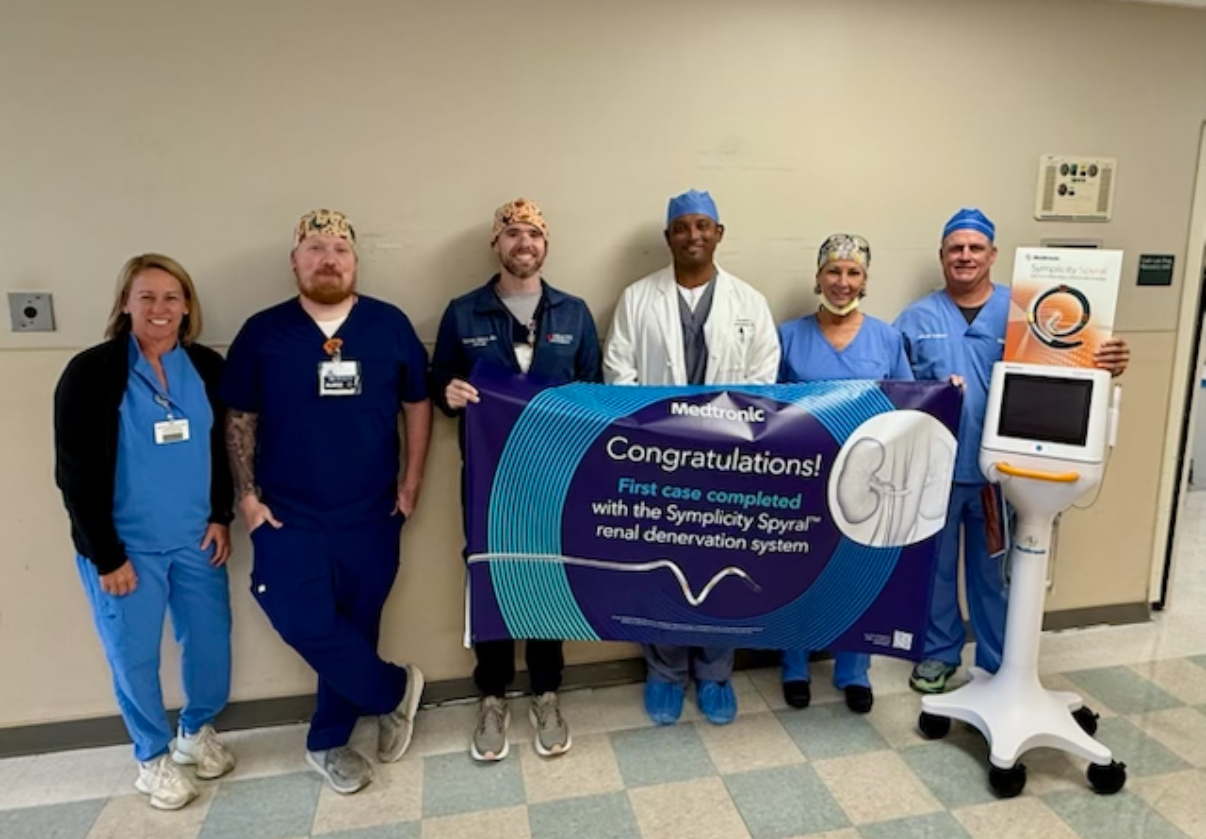
USA Health Providence Hospital recently performed its first renal denervation (RDN) procedure, a treatment for patients whose high blood pressure is not adequately controlled with lifestyle changes or medications alone.
Approved by the U.S. Food and Drug Administration (FDA) in November 2023, the Symplicity blood pressure procedure targets overactive nerves near the kidneys, which can contribute to high blood pressure.
During the procedure, a physician inserts a very thin tube into the artery leading to the kidney. Mild energy is delivered through the tube to calm the overactive nerves, and the tube is then removed, leaving no implant behind.
High blood pressure affects more than 1 billion people worldwide, according to the World Health Organization (WHO). And despite lifestyle changes or medication, many patients still struggle to keep it under control.
“For people with hypertension, medication and/or lifestyle changes can help reduce blood pressure, but studies have shown that many people still don't have it under control,” said Julie Groom, MSHA, BSN, RN, director of cardiology at USA Health Providence Hospital.
“Symplicity can provide patients with a blood pressure reduction benefit and give them peace of mind,” she said. “We are pleased to have treated our first patient with this new technology, and we look forward to the future of hypertension care by offering innovative solutions to the patients we care for.”
Blood pressure measures the force of circulating blood against artery walls. When this pressure stays too high, it can strain the heart and arteries, leading to serious complications such as heart attacks, strokes, heart failure, and kidney disease. Often called the “silent killer,” hypertension frequently goes unnoticed until damage has already occurred.
The Symplicity blood pressure procedure typically takes about 45 to 60 minutes to complete. It is performed under mild sedation in a catheterization lab setting. Most patients go home the same day or after an overnight observation, depending on their individual condition and blood pressure response. Because it is a minimally invasive, catheter-based procedure, recovery is generally quick, and most patients are able to return to normal activities within a few days.
Unlike some procedures that require a permanent device, the Symplicity procedure leaves no implant behind, which reduces the risk of long-term complications such as infection or device failure. Being minimally invasive also means it is performed through a small puncture in the artery rather than open surgery, minimizing bleeding risk and recovery time. The absence of an implant allows the body to heal naturally, while the “always on” effect of the nerve modulation provides continuous blood pressure support without requiring ongoing patient action.
The ideal candidate for the Symplicity renal denervation (RDN) procedure is someone whose hypertension remains difficult to control despite taking multiple blood pressure medications and following recommended lifestyle changes. Clinical studies have shown that patients who undergo RDN experience a sustained reduction in blood pressure compared to those who continue medication alone. On average, participants saw reductions of about 10–15 mmHg in systolic blood pressure both in office and ambulatory settings. These benefits were achieved without major device-related complications, and the effects appear to persist over time.
“Hypertension is the single largest contributor to death and affects about 50% of U.S. adults,” Groom said. “Of the adults that are aware of their hypertension, about 80% do not have it under control. This gives patients an additional option to help control high blood pressure.”