Pathology resident wins Young Investigator Award
The Paul E. Strandjord Young Investigator Award is one of ACLPS’s highest honors for trainees and early-career investigators, recognizing outstanding research presented at the organization’s annual meeting.
By Carol McPhail
[email protected]
First-year pathology resident Katrina Jiang, M.D., represented USA Health’s Department of Pathology at a national meeting of the Academy of Clinical Laboratory Physicians and Scientists (ACLPS) in St. Louis, Missouri, earning the prestigious Paul E. Strandjord Young Investigator Award for her research project on transfusion medicine.
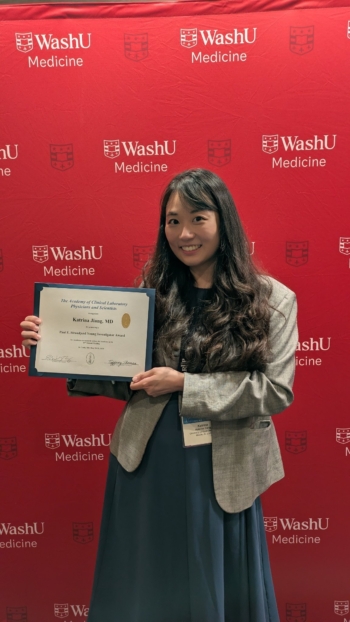
Jiang received the award following an oral presentation of her research on May 29 at the ACLPS Annual Meeting. The presentation, titled “MTP-Predict: A Clinical Scoring System for Identifying Trauma Patients Requiring Large-Volume Massive Transfusion,” was recognized for its scientific merit and contribution to the field of clinical pathology and laboratory medicine. The project was conducted under the mentorship of Mohammad Barouqa, M.D., assistant professor of pathology at the Frederick P. Whiddon College of Medicine at the University of South Alabama.
“I am honored to receive this national recognition from ACLPS and grateful for the support from my department,” Jiang said.
The Paul E. Strandjord Young Investigator Award is one of ACLPS’s highest honors for trainees and early-career investigators, recognizing outstanding research presented at the organization’s annual meeting.
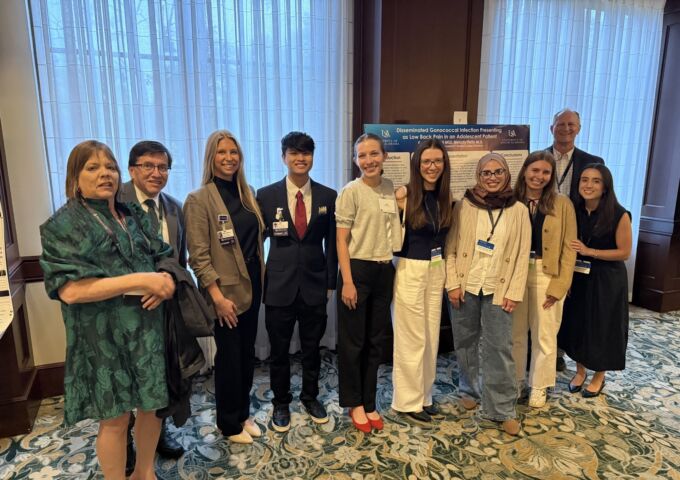
Following the presentation, Jiang was honored at a special awards banquet hosted jointly by the Department of Pathology and Immunology at Washington University in St. Louis and the ACLPS. The event celebrated the achievements of award recipients and highlighted advances in clinical pathology and laboratory medicine research.
Barouqa praised Jiang’s dedication to research, scholarship, and dedication to the field.
Jiang’s achievement reflects the Department of Pathology’s commitment to fostering resident research and supporting the next generation of physician-pathologists, Barouqa said.