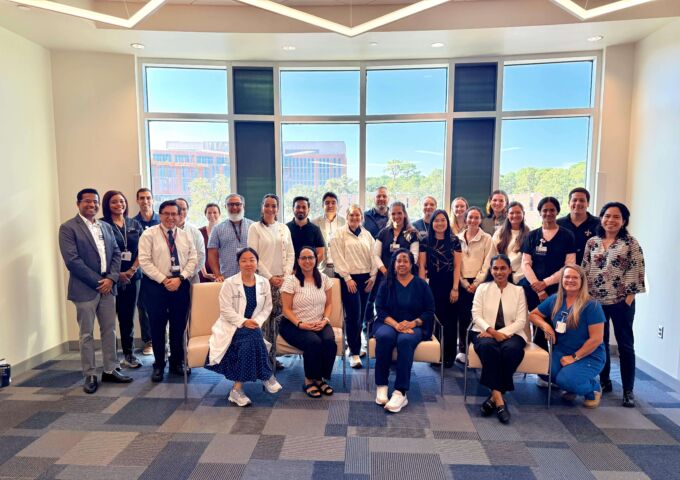

USA Health, Feeding the Gulf Coast create novel care model to address food insecurity with Watershed Health
The closed-loop, scalable care model is critically needed, as roughly 1 in 7 households nationwide (about 47 million people, including over 7 million children) experience food insecurity.
Watershed Health, the company driving patient care coordination across the healthcare ecosystem, on Tuesday announced that, with USA Health, the academic health system for the University of South Alabama, and Feeding the Gulf Coast, a Feeding America food bank serving the central Gulf Coast, they are spearheading a new care model to fight patient food insecurity.
USA Health and Feeding the Gulf Coast serve areas in Alabama, Mississippi, and Florida. When university hospital staff screen a patient and identify food insecurity risk, a referral directly flows in a HIPAA-compliant manner through Watershed Health to Feeding the Gulf Coast, which then connects the patient to food resources, SNAP benefits, and nutrition education. This closed-loop, scalable model is critically needed, as roughly 1 in 7 households nationwide (about 47 million people, including over 7 million children) experience food insecurity.
“Studies show nutrition directly impacts post-hospitalization healing, yet we were continually seeing a disconnect between discharge and food needs, which our studies show is the No. 1 social determinant need amongst our patients. We knew that if we could close that gap at the point of care, we could meaningfully improve outcomes and measure our impact. Watershed Health, which we had already been using for six years, gave us the infrastructure to do exactly that with Feeding the Gulf Coast,” said Dr. Ashley Williams Hogue, trauma surgeon and director of the USA Health Center for Healthy Communities, who leads initiatives that address health disparities and access to healthcare for underserved populations. “This model will be applied to meet other social needs like transportation, housing, educational resources, and beyond, which all directly impact patient health.”
The Institute for Healthcare Improvement provided a grant to USA Health to spur the new model. The health system recently opened an on-site food pantry as its next iteration in fighting patient hunger.
Adults in food-insecure households have higher rates of infections, chronic conditions, and premature mortality. Inadequate nutrition impairs immune response and tissue repair, which contributes to wound complications, higher infection rates, and prolonged recovery. In turn, patients have greater emergency department use, more inpatient admissions, and longer hospital stays. Health care costs for severely food-insecure adults can be more than double those of food-secure adults. Food insecurity also creates a sicker baseline entering surgery or hospitalization, which then shows up in peri- and post-operative outcomes. In trauma patients, food insecurity yields a threefold higher post-operative complication rate (41% vs. 12.5%) and a median length of stay of 13 vs. 5 days.
One in six people in the Feeding the Gulf Coast service area face food insecurity. “Hunger doesn't stop at the hospital door. When a patient is discharged without access to healthful food, their recovery is compromised before it even begins. With USA Health and Watershed Health, we are central to not only reaching people but also impacting health outcomes post-hospitalization, a critical moment when people are at their most vulnerable and nutrition is vital,” said Michael Ledger, president and CEO of Feeding the Gulf Coast.
“With Watershed, the connection between the social intervention and clinical outcome is impactful and direct, not inferred, and that's what makes it measurable and the model replicable in healthcare,” said Effie Carlson, CEO of Watershed Health. “We are free for every provider in the network, from hospitals to physicians to the food bank and every community partner, because better patient outcomes are only achievable when everyone is included in their care. We built our infrastructure with a focus on the whole person, which means we enable the service of any social, clinical, or coordination need for any patient.”