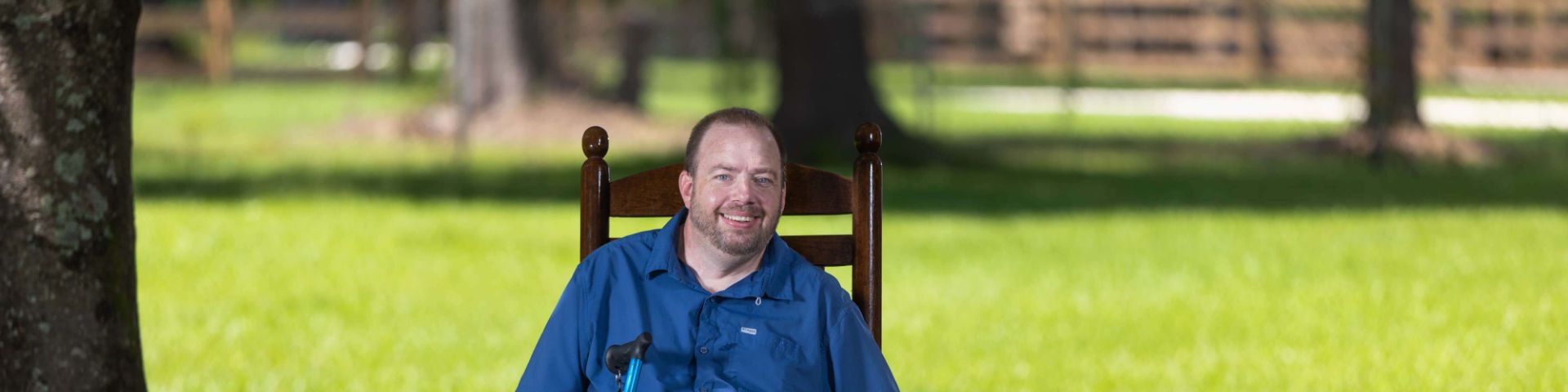
USA Health Magazine: From fighting fires to facing ALS
After decades of serving others, retired firefighter adapts to life with ALS
By Michelle Ryan-Day
[email protected]
This story was originally featured in the Fall 2025 edition of the USA Health magazine.
At age 18, John Heronime discovered he had a gift for serving others. Now 45, the Fairhope resident reminisces over a lifetime spent volunteering at the Fish River Marlow Volunteer Fire Department, working as an EMT, then as a firefighter at a chemical plant before landing at Gulf Shores Fire Rescue, where he served the public for 16 years before an ALS diagnosis forced him to retire.
ALS, also known as Lou Gehrig’s disease, is a rare and progressive neurodegenerative condition that damages motor neurons in the brain and spinal cord. Over time, the damaged neurons no longer send signals to muscles, leading to muscle weakness, paralysis, and eventually difficulties with speech, swallowing, and breathing. There is no cure.
Heronime stumbled upon a career in firefighting following high school. He rose through the ranks, becoming a lieutenant, led fire prevention education at Gulf Shores Elementary School, taught classes in the fire science program at Gulf Shores High School, and, on holidays, prepared German and Polish meals for fellow firefighters and anyone in the community in need.
“The camaraderie was the best part,” he said. “You live with those people a third of your life; and helping people too, that part was nice. Now everybody has to help me, so it’s kind of a weird position.”
Despite ongoing research, the cause of ALS remains unclear. Approximately 10% of cases are inherited, but most are sporadic, with studies suggesting links to environmental toxins, occupational exposures, and military service. Firefighters like Heronime face a higher risk, with several studies associating exposure to combustion byproducts and other environmental hazards with increased ALS incidence.
“It’s thought to be a combination of some environmental factors that we get exposed to and some other underlying genetic process that we don’t fully understand,” said Robert Kobelja, M.D., a USA Health neurologist and medical director of the Kelly Butler ALS Center, where Heronime was referred after diagnosis.
Diagnosis can be complex because early symptoms mimic other conditions, such as orthopedic or nerve compression disorders. Neurologists typically use a combination of physical exams, electromyography, imaging and bloodwork to rule out other causes. On average, the time from first symptom to diagnosis tends to be 18 months to two years, Kobelja said.
Heronime first became concerned about his symptoms in late 2022 while struggling to write a fire report and put on gloves. During a job task review in March 2023, he realized how weak his right hand had become when attempting a rope pull exercise.
Doctors initially diagnosed him with thoracic outlet syndrome, a condition that occurs when the nerves or blood vessels in the space between the collarbone and the first rib are compressed, which can lead to pain, numbness, tingling and weakness. He underwent surgery on his collarbone in April 2023, which was followed by rehab and a return to work in June 2023.
“Post-surgery, it seemed like it got better, but it didn’t,” Heronime said. “I had to do a physical agility test at work, and I wasn’t able to.”
Despite months of effort to regain strength, by October 2023 he could no longer perform critical firefighter drills, as his right hand locked and weakened to the point he could not wear his gloves. He was placed on light duty.
After six months of inconclusive medical evaluations and no diagnosis, the city could no longer hold his firefighting position.
In April 2024, he medically retired; yet the long, frustrating search for answers continued.
Over a two-year span, Heronime went through an extensive diagnostic journey that involved consultations with an orthopaedic physician, two orthopaedic surgeons, three neurologists, and a neurology specialist. He underwent three MRI scans, four nerve studies, multiple X-rays, blood tests, and a major surgery that brought no improvement, until finally his condition had a name.
“On Nov. 11, 2024, I received the news that I had ALS,” he said. “That evening, I shared the news with my parents and niece, and the following day I informed my two closest friends. I was not ready to share with everyone else just yet.”
Despite the lengthy search for answers, Heronime’s case is considered in the early stage, when individuals can usually walk, drive, and manage daily activities, though they may notice muscle weakness, cramping or fatigue.
The middle stage is marked by the loss of driving ability and increasing weakness that may require mobility aids, though individuals are not yet fully dependent on a wheelchair or bed. Speech, swallowing, and breathing changes often become more noticeable.
In the late stage, most people require a wheelchair or become bedbound, with severe weakness affecting movement, speech, swallowing and breathing, often necessitating ventilatory and full-time caregiving support, while cognitive function typically remains intact.
“Thankfully, I am still in the early stage, though I am closer to the middle stage than I want to admit,” he said. “Ziploc bags are a struggle for me, along with twist-off drink tops. Walking unassisted more than 20 feet is no longer a reality. I carry a cane everywhere I go. I still live independently with my two Great Danes, but the list of things I can no longer do grows longer each passing day.”
Heronime credits the support of his parents for his ability to still live independently with his beloved Great Danes, two foster failures from his 20 years of rescuing and fostering the breed. His mother cooks, cleans, washes dishes, does the laundry; and his father mows the lawn, changes the oil in his car, along with other home projects. He’s working on installing an automatic gate to his home.
“Without their love and support, I would not be able to be on my own,” he said. “The helplessness I feel having to watch them do the things I can no longer do is something I cannot explain, but I am forever grateful for them.”
ALS is rare, affecting about five in every 100,000 people, according to the National ALS Registry. While there is no cure, treatment strategies have advanced. FDA-approved medications such as riluzole and edaravone can slow disease progression in some patients. The multidisciplinary approach of the Kelly Butler ALS Clinic works to track disease progression and significantly improve quality of life.
“We have a physical therapist to look at movement or walking ability and decide if they need equipment to help get around safely,” Kobelja said, “or things like electric wheelchairs or transfer devices to help conserve energy. Our occupational therapists look at devices for their hands to help with dressing or eating.”
For Heronime, that support has been invaluable. “The clinic’s been amazing,” he said. “I don’t have to bounce between appointments or make sure one doctor talks to another. Everything is in one place, and the team is on the ball.”
The clinic has connected him with resources for mobility, daily living, and even organizations like the Gleason Foundation, which provided an electric wheelchair to help him maintain his independence.
Still, life is different now for Heronime. It’s not the first time he has faced changes, but he still counts his blessings.
He lost his girlfriend, Chelsea Garvin, a volunteer with the Fish River Marlow Fire Department, in the line of duty following an accident after the Fish River Christmas Boat Parade in 2005.
“I have lived a good life in my almost 46 years on earth,” he said. “I have traveled to Germany with my father, Poland with my mother, Iceland solo and with my oldest niece. I have cruised with friends and family. I have watched national championships live. I found my soulmate and lost her. I worked a job I truly loved. I have had a full life already. I am blessed.”