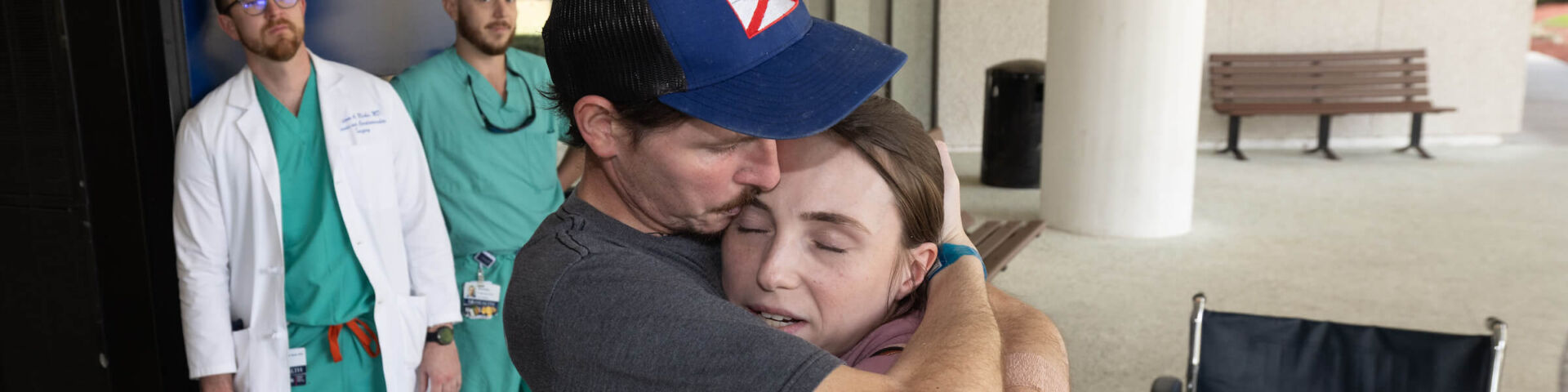
ECMO patient makes an emotional hospital exit after being discharged
After being discharged, Earl Drinkard Jr. was wheeled through the Providence Hospital lobby lined with his caregivers and other staff. They cheered and waved pompoms as he passed by.
By Michelle Ryan-Day
[email protected]
Earl Drinkard Jr., 33, might not have walked out of USA Health Providence Hospital on Friday, April 24, if not for the ECMO program that had been unveiled in early March.
ECMO, or Extracorporeal Membrane Oxygenation, offers an advanced life support option for critically ill patients by taking over the function of the heart and/or lungs when conventional therapies fail, oxygenating blood and maintaining circulation while giving patients time to recover or offering a bridge to transplant or other advanced therapies. Providence recently became the first hospital in the region to offer this potentially lifesaving care.
When Drinkard contracted what he thought was a seemingly minor cold, he even joked about it with his wife, Victoria.
“It started with a scratchy throat,” he said. “I remember telling my wife, ‘Here comes a dramatic man-cold; my throat is scratchy.’” They both laughed.
In three days, though, his condition escalated. His wife and children woke up on a Wednesday morning to a house decorated for their son’s 7th birthday, but Drinkard was still sleeping on the couch.
“I ran over to try to wake him up, and he wouldn’t budge,” his wife recalled. “He was responding some, but I couldn’t wake him up no matter how hard I tried.”
She called 911. Mobile County EMS responded and immediately went to work to help Drinkard get oxygen while his children watched, terrified.
According to Mobile County EMS, his care began long before he reached the hospital. Drinkard was resuscitated in the field, where a critical care paramedic performed rapid sequence intubation and placed him on a mechanical ventilator, offering advanced lifesaving interventions not commonly available in a 911 response system.
“One of the medics came over and told me they were going ahead and hanging an IV bag,” his wife said.
Even then, the severity of the situation had not fully registered. It would later become clear that Drinkard was in full respiratory failure before the ambulance ever left the driveway.
“They took him to the closest hospital, which thankfully was Providence,” she said. “What a blessing that was. We had no idea they had just started the ECMO program, but the thought he would need that didn’t even cross my mind.”
After an especially rough night in the intensive care unit, his wife received a call from a nurse who told her about ECMO. Will Ricks, M.D., a cardiovascular surgeon and director of the USA Health ECMO program, then explained the procedure over the phone and got her consent to proceed.
“I got dressed faster than ever before, dropped my kids off at my mom’s, and ran to the hospital,” Victoria said. “I sat in the waiting room praying Earl would be OK, waiting for someone to come tell me he made it through the procedure.
“Dr. Ricks eventually came in and talked to me about everything for at least an hour,” she said. “He was so thorough and assured me he was doing everything he could for my husband.”
All told, Drinkard spent 24 days in ICU, battling a severe case of strep B and pneumonia, which together can cause severe, life-threatening complications.
“I do not think he would be alive today without ECMO,” Ricks said. “And in the small chance he was, I suspect he would have had irreversible lung injury.”
After being discharged, Drinkard was wheeled through the Providence lobby lined with his caregivers and other hospital staff. He held his wife’s hand as they cheered and waved pompoms as he passed by.
“I was in the moment, happy, surreal. Honestly, I have been fighting to get home, and that moment was one of the happiest moments of my life,” Drinkard said. “Seeing all my support teams and all the staff and doctors cheering me and my wife along, because it wasn’t just for me; my wonderful wife was there battling this with me the whole time.”
When he got out of the wheelchair at the hospital entrance, the crowd erupted with even louder cheers.
“It was very moving to see a patient who had been so sick literally walk out of the hospital. It was a reminder of why we practice as physicians, to help people overcome sickness and get back to life with their families,” Ricks said. “I think it highlights the dedication of our team of ICU nurses, ECMO specialists, respiratory therapists, physical therapists, and pharmacists working endless hours to progress care and save his life.
“This is the reason we wanted to bring ECMO to Mobile, and it demonstrates the value to our community.”
The Drinkard family is thankful to the hospital staff who supported them during some of the worst days of their lives.
“I will never have the words to express to them how much they mean to me and how big of an impact they have made in our lives,” Victoria Drinkard said. “I love every single one of you guys so much.”
The ECMO program is funded in part through State and Local Fiscal Recovery Funds (SLFRF) under the American Rescue Plan Act, administered by the Mobile County Commission. USA Health is grateful for the support of the Mobile County Commission and Commissioner Randall Dueitt, District 3, whose partnership has been instrumental in making this project a reality.
For Earl and Victoria Drinkard, the timing was a godsend, but not just for them.
“Mobile has needed this for a very, very long time, and we are so honored to be a part of something that is going to have such a huge impact on our city,” Victoria Drinkard said. “I can’t wait to see all of the lives that get saved now that we have access to such an amazing program right at home.”