Sarkar awarded American Cancer Society grant to advance colon cancer research
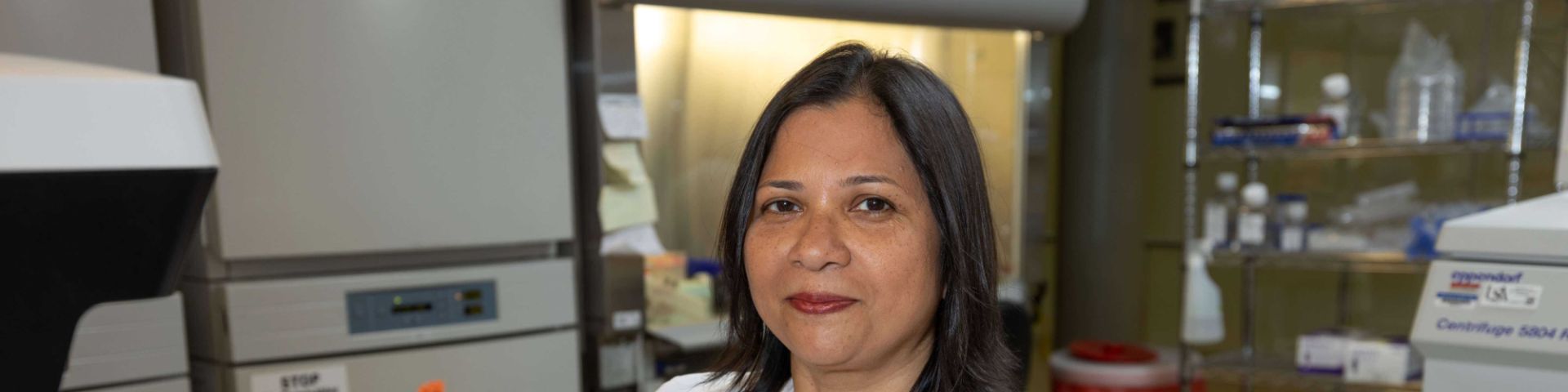
Chandrani Sarkar, Ph.D., a cancer researcher at the Mitchell Cancer Institute and an assistant professor of pathology at the Whiddon College of Medicine, serves as principal investigator of the project.
By Lindsay Hughes
[email protected]
With support from a four-year, $946,000 grant from the American Cancer Society (ACS), researchers at the University of South Alabama will investigate how immune cells called macrophages are regulated in colon cancer — work that could lead to new treatment strategies for one of the most lethal cancers worldwide.
The project will be led by Chandrani Sarkar, Ph.D., a cancer researcher at the USA Health Mitchell Cancer Institute and an assistant professor of pathology at the Frederick P. Whiddon College of Medicine. Sarkar serves as principal investigator on the grant.
Colon cancer is among the most common cancers in both men and women, and its high mortality rate stems largely from its ability to metastasize, or spread, to other organs. Nearly half of patients diagnosed with colon adenocarcinoma develop liver metastases, and survival rates drop sharply once the disease advances. While localized colon cancer carries a five-year survival rate of nearly 90%, that figure falls to just 15% for patients with metastatic disease, according to ACS data.
Although most primary colon tumors can be removed surgically, metastatic tumors often do not respond effectively to surgery, radiation or chemotherapy. In recent years, new treatment approaches have provided modest improvements in outcomes, but metastatic disease remains a major cause of cancer-related death.
Sarkar’s research centers on macrophages, a crucial cellular component of the tumor microenvironment. Depending on the cues they receive, macrophages can exhibit either pro-tumor or anti-tumor properties. Tumor-associated macrophages (TAMs), the most abundant immune cells present in colon cancer, play a crucial role in cancer progression and metastasis. By studying how TAMs are regulated within the tumor microenvironment, Sarkar and her team aim to identify ways to “re-educate” these cells to fight cancer instead of fueling its progression.
“Currently, there are limited treatment options for patients with metastatic disease, and the prognosis is very poor,” Sarkar said. “Understanding the molecular mechanisms of macrophage regulation will reveal new targets for therapy and aid in the development of novel, targeted therapies for colon cancer.”
Current macrophage-associated therapies exhibit several shortcomings, Sarkar said, including poor efficacy and adverse side effects, and warrant further investigation. Her study will focus on the molecular drivers of TAM activity, seeking insights that could overcome those challenges and expand treatment options for patients.
Collaborators on the project are Debanjan Chakroborty, Ph.D., assistant professor of pathology; Guillermo Herrera, M.D., professor and chair of pathology; Richard Honkanen, Ph.D., professor and chair of biochemistry and molecular biology; Paramahansa Pramanik, Ph.D., assistant professor of math and statistics; and Ahmed Abdalla, M.D., assistant professor of interdisciplinary clinical oncology.
Sarkar joined USA Health and the Whiddon College of Medicine in July 2021. She earned a Ph.D. in cancer biology from Jadavpur University in Kolkata, West Bengal, India, and completed a postdoctoral research fellowship at Mayo Clinic in Rochester, Minnesota. She also holds a Master of Clinical Research from The Ohio State University in Columbus, Ohio.
Her research has been published in high-impact, peer-reviewed journals, and she has presented her work nationally and internationally.