USA Health study compares outcomes for robotic, laparoscopic esophageal surgery
The study analyzed a database of more than 100 patients who had undergone a Heller myotomy, confirming that the robotic approach resulted in fewer perforations of the esophagus and shorter hospital stays than did the laparoscopic approach.
By Carol McPhail
[email protected]
Robotic surgery can make esophageal procedures safer, lowering the risk of accidental perforations during surgery and enabling patients to leave the hospital sooner, according to a study led by surgeons at USA Health, the academic health system for the University of South Alabama.
The study was published in April in the Journal of the American College of Surgeons, a scientific, peer-reviewed publication.
“In my opinion, our study shows a significant advancement in surgical outcomes using the latest techniques of robotic surgery,” said William O. Richards, M.D., FACS, a surgeon at USA Health and professor and chair of the Department of Surgery at the Frederick P. Whiddon College of Medicine at USA.
Richards was one of three authors of the study along with Megan McCaul, M.D., a bariatric surgery fellow at Vanderbilt University who trained at USA Health, and Juan Borja, M.D., a current surgery resident.
The study analyzed a database of more than 100 patients who had undergone a Heller myotomy, confirming that the robotic approach resulted in fewer perforations of the esophagus and shorter hospital stays than did the laparoscopic approach.
A Heller myotomy is a minimally invasive surgical procedure used to address achalasia, a swallowing condition that affects the esophagus. The procedure involves cutting the muscles of the lower esophageal sphincter to improve swallowing and prevent complications like aspiration and malnutrition.
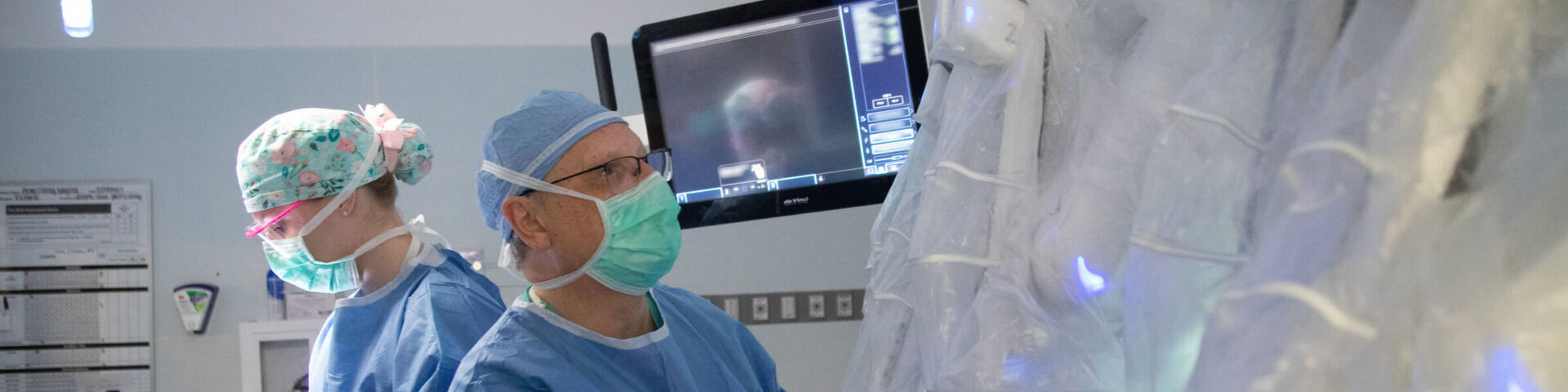
A surgeon can perform a myotomy laparoscopically using a thin telescopic rod with a tiny video camera, or robotically by controlling robotic arms from a console while viewing a 3D high-definition image of the surgical site.
“At the University of South Alabama, after switching from a laparoscopic to robotic platform, we noticed improvement in our ability to perform a more complete myotomy without intraoperative perforation and improved shorter-term patient outcomes,” the authors wrote. “Due to this observation and the inconsistent findings in the current literature, we designed a retrospective cohort study to compare the short- and long-term outcomes of robotic Heller myotomy to laparoscopic Heller myotomy.”
Richards said the specific benefits of robotic surgery for surgeons include binocular vision, increased dexterity and adjustable hand-control speed. “It enables the surgeon to precisely cut the muscle while leaving a thin layer of mucosa,” he said.
USA Health utilizes six da Vinci Xi robot systems, which are used in a wide variety of lung, mediastinal (chest cavity) and esophageal surgeries.
The authors presented their findings at the Southern Surgical Association’s 137th annual meeting in December 2025.