USA researchers showcase teaching kitchen research at national conference
Teaching kitchens have the potential to become an important component of medical education and patient care, particularly as healthcare providers address conditions in which lifestyle plays a significant role.
By Michelle Ryan-Day
[email protected]
Researchers and educators from the University of South Alabama, including USA Health, recently joined hundreds of colleagues from across the nation and around the world to share emerging research on the role of teaching kitchens in health care and medical education.
Robert Israel, M.D., FACP, director of the Integrative Health and Wellness Program at USA Health, David Weber, Ph.D., professor of physiology and cell biology, and Carrie McNair, MPH, a research assistant in Cancer Control and Prevention at the USA Health Mitchell Cancer Institute (MCI), attended the Teaching Kitchen Research Conference in Boston.
Weber presented research examining the impact of teaching kitchen experiences on medical students’ nutrition knowledge and confidence in discussing nutrition with patients.
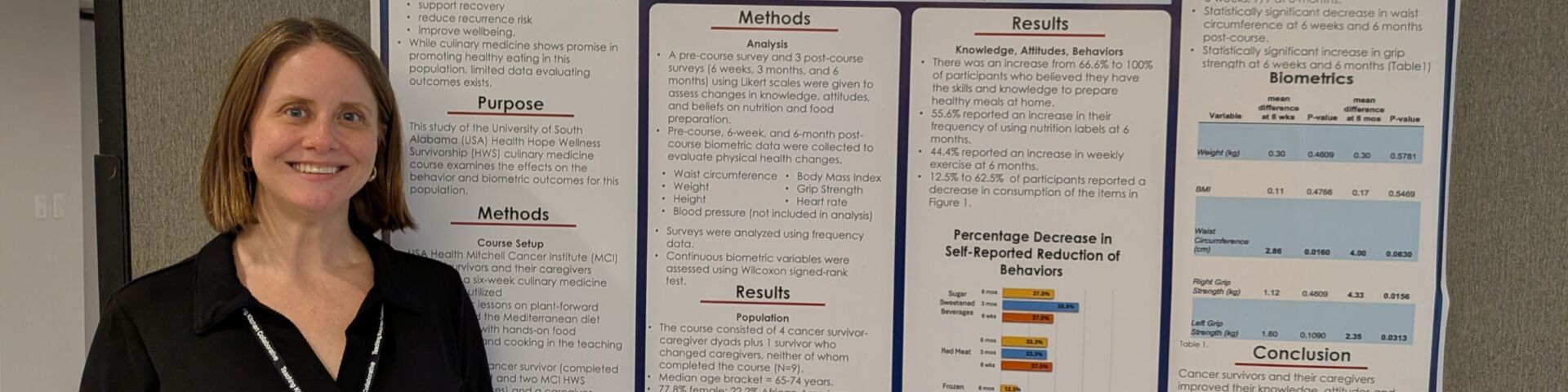
McNair also presented a poster highlighting research on the impact of a culinary medicine program on cancer survivors and caregivers.
The conference brought together approximately 360 researchers, clinicians, chefs, program leaders, and other professionals from 39 states and 11 countries. The two-day meeting featured 60 speakers, including invited speakers and presenters of 37 oral abstracts, as well as 44 poster presentations.
Since 2021, USA Health has been a member of the Teaching Kitchen Collaborative, a national network focused on advancing the use of teaching kitchens in healthcare, education, and research.
Research shows benefits of culinary medicine
McNair’s poster, “Evaluating the Impact of a Culinary Medicine Program on Knowledge, Attitudes, and Biometric Outcomes among Cancer Survivors and Caregivers,” examined recent data from participants in MCI’s Hope Wellness Survivorship program.
Participants completed a six-week culinary medicine course in the University Commons teaching kitchen led by Israel and Margaret Kappel, manager of the Integrative Health and Wellness Program. USA Whiddon College of Medicine student Jayne Freeman conducted the data analysis.
The study found statistically significant changes in waist circumference and grip strength, along with improvements in participants’ self-reported healthy eating behaviors. The improvements in knowledge, attitudes, and behaviors, as well as beneficial biometric changes, were observed for up to six months following the course.
“Our study revealed that cancer survivors and their caregivers improved their knowledge, attitudes, and behaviors about healthy eating and made beneficial biometric changes for up to six months after the six-week culinary medicine course,” McNair said.
McNair said the findings suggest that culinary medicine courses can help cancer survivors and their caregivers make meaningful healthy eating changes that last. “We hope to continue working with this population to look at long-term effects,” she said.
Israel said the teaching kitchen provides people the opportunity to learn in a meaningful way how to cook healthy meals that taste good and are budget friendly. “After a class or two, we see people trying recipes and making steps that impact their health," he said.
Traditional nutrition information can sometimes leave people unsure about how to put recommendations into practice, Israel said.
“When we simply hand them diet information, it is frequently overwhelming and impossible for them to see how they can incorporate healthy cooking into their daily life,” he said. “The classes help them see a way forward.”
Preparing future physicians
Weber’s oral presentation, “Impact of Teaching Kitchen Integration on Medical Student Nutrition Knowledge and Clinical Confidence,” focused on the role hands-on nutrition education can play in medical training.
Students consistently reported greater confidence in discussing nutrition with patients and translating nutrition concepts into practical guidance, Weber said.
The strongest gains occurred in areas that can be difficult to learn through traditional classroom instruction alone, including explaining dietary patterns, discussing a whole-food approach to eating, and helping patients understand basic food preparation.
Students emphasized hands-on learning and its direct connection to patient care.
The study measured students’ confidence rather than directly testing their performance in clinical practice, Weber said. However, consistent findings across three consecutive classes suggest that teaching kitchens can help bridge the gap between learning about nutrition and feeling prepared to discuss it with patients.
“Physicians routinely care for patients whose health is influenced by diet, but knowing nutritional science is different from being able to translate that knowledge into realistic advice,” Weber said.
Practical nutrition education gives future physicians an opportunity to consider how recommendations work in everyday life, including factors such as food preparation, cost, taste, time, access, and cultural preferences.
“We are not trying to turn physicians into dietitians,” Weber said. “It is to prepare them to initiate informed conversations, reinforce appropriate recommendations, recognize when specialized nutrition support is needed, and collaborate effectively with dietitians and other health professionals.”
Expanding the role of teaching kitchens
The conference also provided an opportunity for the USA team to learn from other teaching kitchen programs while sharing the university’s own experiences.
Israel said teaching kitchens have the potential to become an increasingly important component of medical education and patient care, particularly as healthcare providers address conditions in which lifestyle plays a significant role.
“There is a great opportunity to add meaningful learning for our medical students and residents — for example, around the use of the new GLP-1 drugs and lifestyle change, how to treat and at times cure Type 2 diabetes, improve cancer outcomes, reduce heart disease and much more,” Israel said.