USA Health Magazine: Inspired to give back
Jamael Nettles has just earned a bachelor’s degree in nursing, a path he chose because of his own experience as a patient at USA Health.
By Casandra Andrews
This story was originally featured in the Summer 2026 edition of the USA Health magazine.
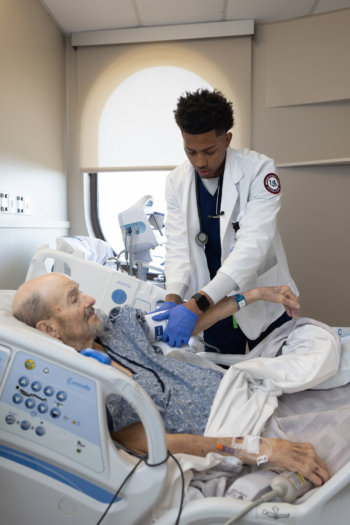
When Jamael Nettles, 22, looks back on his path through nursing school at the University of South Alabama, he’s quick to recognize the USA Health team members who helped him navigate the challenges that came with enduring multiple surgeries related to spina bifida during his high school years.
To see the healthy and vibrant young man he is today, you might never know he suffered through months-long stretches of excruciating pain. That he survived a dozen operations without permanent paralysis. That he used a wheelchair, wore adult diapers, and learned to walk again multiple times before USA Health physicians implanted a device in his side that changed his life, just days before his high school graduation.
During a clinical rotation last fall, Nettles trained in the pediatric intensive care unit at USA Health Children’s & Women’s Hospital, a place he vividly remembered from his teenage years. “Nurses have had a huge impact on my life,” he said. “And now I want to be that motivation in someone else’s life. I know the difference that it made for me.”
Even though it was more than 20 years ago, Nettles' parents remember the conversation like it was yesterday. Their 8-month-old had just been rushed to a hospital four hours away from Mobile. He was suffering from complications related to the most serious form of spina bifida, a condition that occurs when the spine and spinal cord don’t form the way they should.
After the Nettles family’s long ambulance ride, a specialist examined their baby and gave the new parents a frightening choice. “He said, ‘If I don’t do the surgery, he will never be able to walk,’” recalled Nettles’ mom, Jazzmon Arnold, adding that a doctor also told them, “Or we can do surgery, and I can hit the wrong nerve and paralyze him.”
They had just two hours to decide.
Time was of the essence because of the type of spina bifida Nettles was born with. Known as myelomeningocele, or open spina bifida, it is considered the most severe form. With myelomeningocele, part of the spinal cord – including its protective covering and spinal nerves – pushes through the opening at birth, forming a sac on the back. Tissues and nerves are typically exposed, making a baby prone to life-threatening infections. This type of spina bifida may also cause loss of movement in the legs, plus bladder and bowel dysfunction. Severe, debilitating pain is also common.
After weighing the options, his parents chose the operation – a complicated procedure doctors told them would take about eight hours. Terrified for their son, they huddled in the waiting room, praying for a good outcome. They didn’t have to wait long. “About three hours in, I see the doctor come out,” Arnold recalled. “He said the surgery was so successful it only took three hours.”
In the days following the surgery, there were concerns that Nettles might not be able to stand or walk. But a few months after celebrating his first birthday, the little boy defied the odds. “He had a lot of energy,” said his father, Jamael Nettles Sr. “He started walking and then started running and jumping. The doctors were so surprised. They couldn’t believe it.”
Thankfully, the next 14 years were filled with mostly uneventful follow-up visits to a spina bifida clinic out of town and appointments with local specialists. Nettles loved to play basketball and even had quiet hopes of playing in college or beyond. But as he grew taller, his spinal cord issues emerged again.
Before school one day in 10th grade, he noticed a swollen spot on his lower back. By the time basketball practice rolled around that afternoon, he was in so much pain his family took him to the emergency department at Children’s & Women’s Hospital.
Because he was under the care of another provider, Nettles was referred to the out-of-town hospital. All told, he would have three more surgeries there to treat issues surrounding tethered cord syndrome and spina bifida. Each time, Nettles would improve for a few days or a few weeks, and then the pain and other health issues would return, often leaving him lying face down in a hospital bed, crying out in agony.
“It was a nightmare for three and a half years,” his father said. “In and out of the hospital. Trying to figure out how to take care of him emotionally. As a parent, my job is to provide and protect, and I couldn’t protect him from what he was going through.”
Eventually, the out-of-town physicians told his family there was nothing more they could do.
“Once they denied the case, we felt hopeless,” Nettles said. “My dad broke down. It was the possible reality of always being in agonizing pain, always having to be medicated.”
Looking back, Nettles said, he found himself slipping into depression. “I wanted to play sports, go to the fair and the beach. I was watching events go by. It was really hard.”
Still seeking answers and relief, Nettles and his parents made an appointment with Anthony Martino, M.D., a neurosurgeon at USA Health who also serves as chair and professor of neurosurgery at the Frederick P. Whiddon College of Medicine at USA.
“When Dr. Martino stepped in, it was like a miracle,” Nettles said, adding “like God sent him to us.”
After explaining the possible complications, including paralysis, Martino performed a fifth surgery on Nettles. “It was a sacrifice I was willing to take,” Nettles said.
Over the course of three years, Martino and his team performed nearly half a dozen surgeries and procedures, all with the goal of alleviating the intense pain that stemmed from issues related to Nettles’ spina bifida and tethered cord syndrome.
Eventually, the neurosurgeon told them that additional operations would increase the risk of permanent paralysis.
With conventional treatment options exhausted, Martino pursued innovative approaches to address his patient’s condition. Consulting with pain management colleagues at USA Health, the team devised a novel way to manage Nettles' pain. When he and his family were presented with the option of implanting a spinal cord stimulator, they agreed.
A little wider than a half-dollar coin, a spinal cord stimulator blocks pain by sending low levels of electricity to the spine and nerves. This can change the way some people feel pain. When Nettles woke up from the operation, he remembers being able to tell immediately that things were significantly better.
His mom called it an answer to prayer.
“The next day all of his (internal) pain was gone,” his mother said. “I was like, 'Oh my God. We finally got something to work. This is really working.'”
That was almost four years ago.
Because of his surgeries and extended hospitalizations, Nettles ended up missing 52 days of school during his senior year at Mary G. Montgomery High School. “He still had a 4.2 GPA and received a full-ride scholarship,” his mom said proudly.
Nettles was the recipient of a Joseph Treadwell Foundation Scholarship at USA, a four-year award that is given to students, recommended by their high school guidance counselors, who have overcome great obstacles.
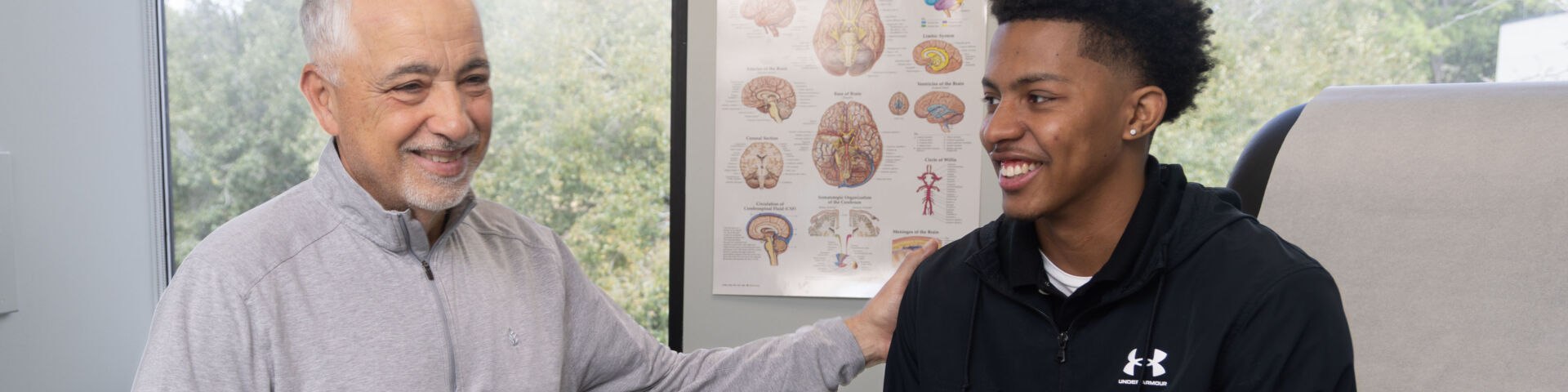
This spring, as he prepared for graduation from nursing school, Nettles met with Martino in his office on the campus at USA Health Providence Hospital. The neurosurgeon showed him images of his spinal cord, and they talked about how far he has come. At the end of the visit, they embraced and made plans to stay in touch.
“We are thrilled with the results,” Martino said of Nettles’ surgery to implant the stimulator. “His pain is under control, and he essentially has full functional ability. It’s fabulous.”
On a recent morning, Nettles strode briskly down a 10th-floor hallway at Providence Hospital for another round of clinical training with patients and other professional healthcare team members. On this day, he was tasked with giving medications, taking vital signs, and making sure his patients had everything they needed.
He knocked on a door, then walked in to introduce himself. The patient looked up and smiled, extending his arm for a blood pressure cuff.
“I’m extremely proud of him,” Nettles' dad said. “I tell him all the time his character will take him further in life than anything. And the fact that he didn’t give up. A person (who endured the pain he did) could give up. But he refused to give up, and I’m so proud about that.”