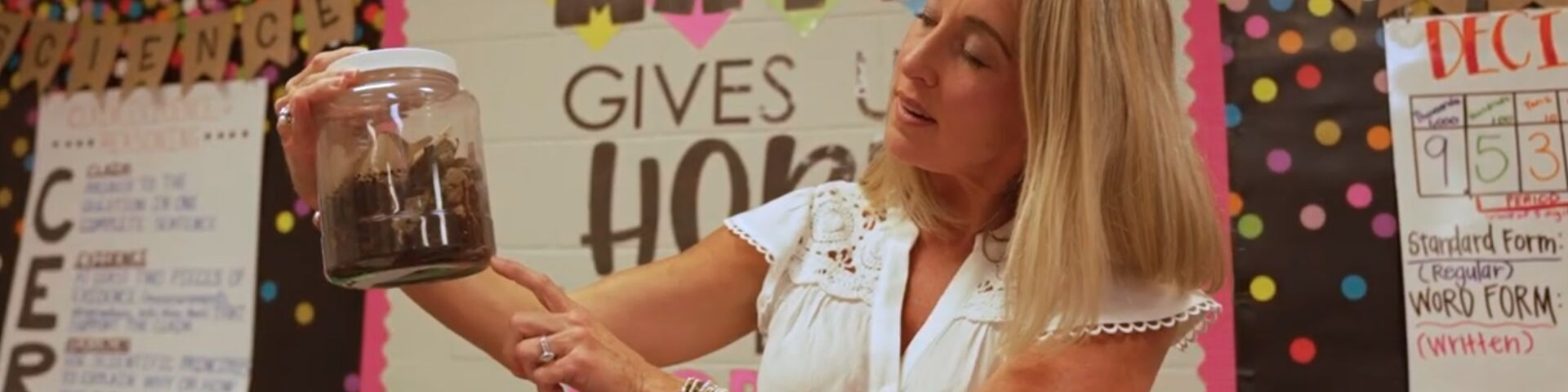
Local teacher overcomes high-risk brain tumor with family, surgical team support
Jennifer Rowland continues to inspire students and colleagues, demonstrating her resilience, faith, and determination.
By Jessica Jones
[email protected]
Jennifer Rowland, a mother of six and longtime teacher at Saraland Elementary, never imagined the intense headaches she had been experiencing would lead to a life-changing diagnosis. One evening, as she and her husband were picking up dinner, a call came that changed everything.
“The neurologist called me on Friday afternoon around 5 p.m. and said they saw something on my MRI scan,” Rowland recalled. “He said they didn’t want to alarm me but that I had a brain tumor and I needed to go to the emergency room at University Hospital right away. He said a doctor, Dr. Thakur, would be there waiting for me.”
Rowland had noticed symptoms, including severe headaches and nausea, and even suspected something was wrong. But the confirmation still came as a shock. “Before I was diagnosed, I remembered thinking, ‘what if it’s a brain tumor?’ and not actually expecting it to be. But, you know, your mind always goes to the worst possibility. And the fact that it was true was scary.”
That night, Rowland and her husband immediately drove to the hospital. “They were waiting on me. I never even sat down. The admissions team started caring for me and within 30 minutes I met Dr. Thakur.”
Jai Thakur, M.D., FAANS, chief of minimally invasive cranial and skull base neurosurgery at USA Health, received the MRI scans which revealed a highly vascular tumor known as a hemangioblastoma pressing on her brainstem, cerebellum, and spinal cord, a location that made it high risk.
“This was an extremely challenging tumor,” said Thakur, who also serves as an associate professor at the University of South Alabama Frederick P. Whiddon College of Medicine. “It involved multiple critical structures, including blood vessels and cranial nerves that control day-to-day functions like swallowing, breathing, talking, and heart rate — things that we don’t even think about doing. If left untreated, the tumor could have caused permanent damage and could have even been fatal.”
Rowland’s strength and resolve were evident from the first consultation. “She told me, ‘Get me all fixed up. I have six kids,’” Thakur said. “It's important for me to connect to my patients. And I think just knowing how strong she is, knowing that she trusts us with this, understanding the risks and benefits and then having incredible family support, which she had, were all the highlights when I met her.”
The days that followed were a blur for the family. After initial scans and consultations, Rowland was prepared for surgery. “It felt like everything was moving very quickly,” said Rowland’s husband, Tre. “We didn’t have much time to process. You just focus on the next step.”
Rowland was diagnosed October 22, 2021, when COVID-19 restrictions added another layer of challenges. Only adults could enter the hospital then, so children could not visit. While difficult, the couple said that gave them some time to process the diagnosis and prepare for her brain surgery.
“We had a couple of days to get through the weekend together, just the two of us with hospital staff,” Rowland’s husband said. “It gave us a chance to lean into the surgery, pray together, and mentally prepare for what was ahead.”
Support came not only from each other but also from extended family, friends, church members, and school colleagues. Her husband remembers sitting under a large oak tree outside the hospital while Rowland underwent surgery, surrounded by family and school staff who offered comfort and solidarity. “We ate lunch together and shared stories,” he said. “It was a moment of family coming together.”
The eight-hour surgery was a far-lateral skull base procedure, a modification of traditional craniotomy techniques. Thakur and his team carefully navigated around the vertebral artery and other critical cranial nerves. “Knowing the relationship between the tumor and these structures is crucial,” Thakur said. “Any mistake could result in devastating consequences, including stroke or permanent neurological deficits.”
The tumor measured roughly 3.5 to 4 centimeters, just shy of the size of a golf ball, unusually large for its location. Thakur said the team slowly and meticulously removed it, ensuring the blood supply to surrounding tissues was preserved while the tumor was separated from the brainstem and spinal cord.
Her recovery was rapid. Rowland went home just two days after surgery, defying expectations and demonstrating her determination to return to her family and classroom.
Nearly four years after her surgery, Rowland remains tumor-free, with no signs of recurrence. Thakur says that while the tumor was benign, its aggressive vascular nature and location made it particularly dangerous.
Rowland reflects on the journey with gratitude. “There’s no doubt that God has been writing my story,” she said. “I’m thankful that He led me to Dr. Thakur and the team at USA Health, because I just don’t feel like the outcome would have been the same if I’d have been somewhere else.”
She continues, “Of course I know that Dr. Thakur, his team, and the USA hospital are the best in Mobile, but from my experience I would say they are the best in the world. If I had to do it all over again, I would definitely entrust my journey to them.”
Rowland returned to her classroom the next February, just three and a half months after the operation. She continues to inspire students and colleagues, demonstrating her resilience, faith, and determination.