Staying at South: Why USA medical students continue their residencies at USA Health
Six former medical students at the Frederick P. Whiddon College of Medicine, now residents in internal medicine, share why they chose to continue their training at USA Health.
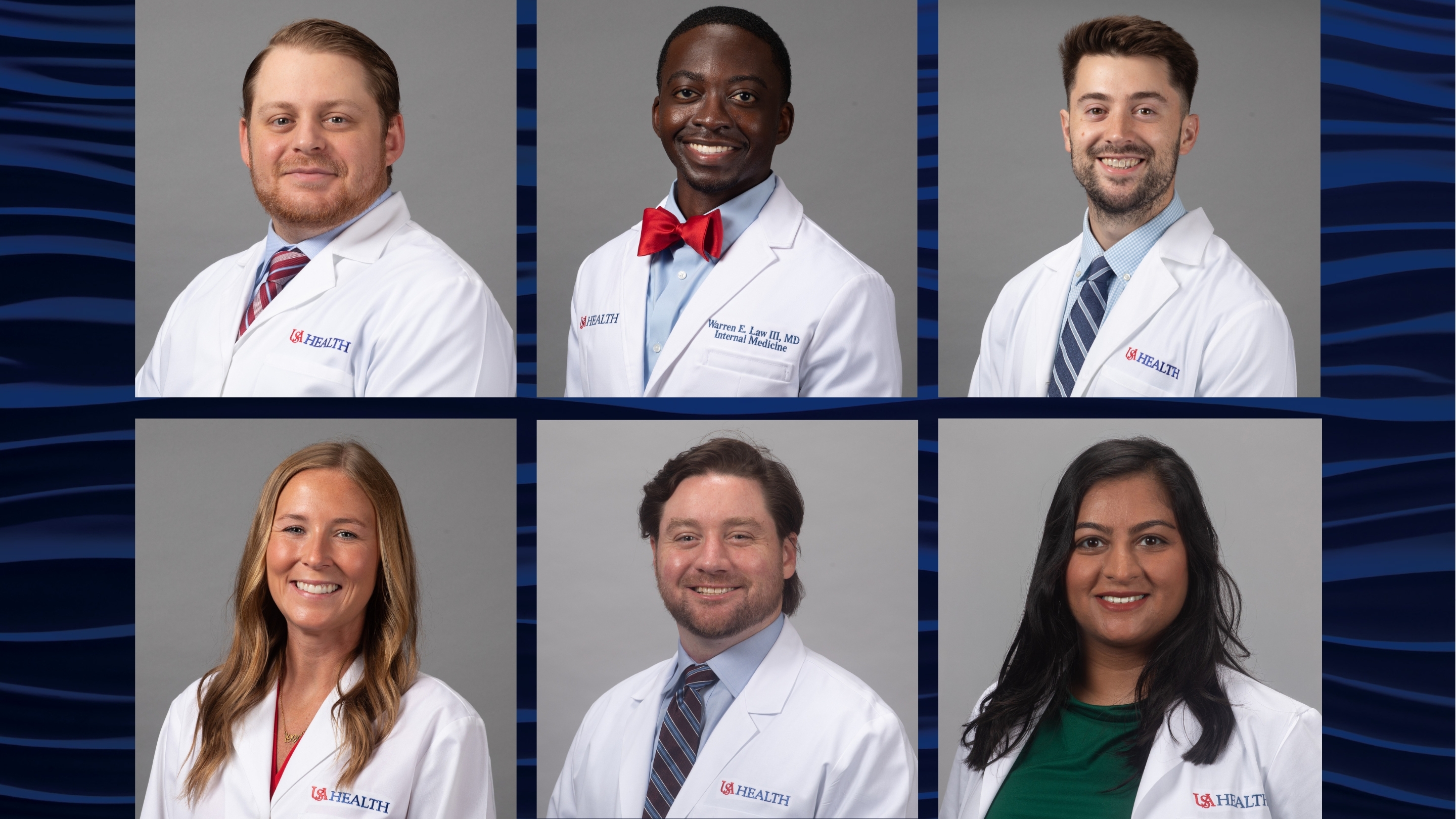
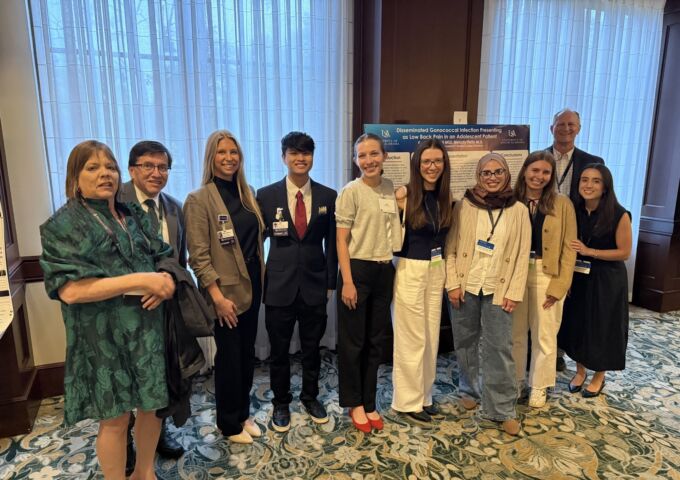
Bottom row: Katelyn Harwell, M.D.; Kelley Cutrell, M.D.; Leena Patel, M.D.
By Michelle Ryan-Day
[email protected]
For many medical students, Match Day marks a move to a new hospital in another city. But for others, the next step doesn’t require packing up. Six former medical students at the Frederick P. Whiddon College of Medicine at the University of South Alabama share why they made the choice to stay in internal medicine and build on a foundation they had already formed as they continue their training in a place that already felt like home.
For first-year resident Warren Law III, M.D., the choice was rooted in something deeply personal: community. During his time as a student, he experienced an environment where learners are not only supported, but genuinely valued.
“Everyone, from students to faculty, helped build a culture of respect, professionalism, collaboration, innovation, and inclusivity,” he said. “It’s the kind of place where I want to keep growing.”
Being from Mobile, his decision also reflects a strong sense of purpose. Staying allows him to continue caring for the very community that shaped him.
“I’ve always felt a strong commitment to this community,” he added. “Staying here allows me to keep serving the people and families who influenced my journey while continuing to grow within a program that embodies patient-centered medicine.”
He also emphasized the program’s close-knit nature, noting that “the smaller size creates a tight-knit community where residents really know their faculty and each other,” and that it’s “a place where I’d be seen, supported, and challenged to grow.”
That sense of belonging is a recurring theme among residents who choose to stay. Fellow first-year resident Katie Harwell, M.D., described her experience as one where she felt like a member of the team from day one. “I always felt valued as a member of the team, which gave me confidence and helped me thrive,” she said.
Surrounded by supportive residents, engaged faculty, and a diverse patient population, she found both challenge and encouragement. “This combination of supportive mentorship and meaningful clinical experiences made me feel at home here,” she said.
Harwell also pointed to the program’s responsiveness and culture of improvement. “Resident feedback is not only welcomed but acted upon, which fosters an environment of continuous growth,” she said. “The emphasis on wellness, mentorship, and adaptability ensures I’ll develop not just strong clinical skills, but the resilience and leadership needed for a long career.”
Others point to the unique clinical opportunities available. Third-year resident Kelley Cuttrell, M.D., emphasized the breadth and depth of training, noting exposure to complex cases typically seen at a regional referral center. “Patients traveled hours for advanced subspecialty care, from hepatology to pulmonary hypertension to oncology,” he said.
From advanced subspecialty care to hands-on procedural experience, he found a balance of autonomy and support that challenged him. “My input was consistently valued, and feedback was met with responsiveness,” he said. “Faculty were eager to mentor and collaborate directly with residents.” Opportunities for research and presenting at and attending professional conferences also helped position him for future success.
For first-year resident Nick Friend, M.D., familiarity played a powerful role. After spending years collaborating with residents and faculty, he had already seen what the program offered, not just during interviews, but in day-to-day practice.
“Being a student here gave me a behind-the-scenes look at the program,” he said. “Everybody was always willing to teach. I knew this would be a place where I could thrive. I didn’t know if that would be true anywhere else.”
At the same time, life outside the hospital also mattered. Matching alongside his wife and starting a family, he found a program that supported both his professional ambitions and personal life. “Both programs here were highly supportive of us,” he said. “We knew we would have a great foundation for success.”
Similarly, first-year resident Sidney Bailey, M.D., saw staying as an opportunity to strengthen both professional and personal roots. “I was able to establish tremendous relationships with faculty and staff,” he said, pointing to the importance of those connections in his decision.
With family considerations and a shared commitment to building a future on the Gulf Coast, he recognized the value of training in a region that serves a wide and often underserved population.
“Our residents get vast amounts of experience with a diverse patient population,” he said, including both common conditions and rare, complex cases. “The longer you work with the same members of the healthcare team, the more cohesive care can become.”
For third-year resident Leena Patel, M.D., flexibility and mentorship were key. Unsure of her long-term career path, she was drawn to a program that could support multiple directions.
“I wanted a program that could support me whether I pursued subspecialty care, hospital medicine, or primary care,” she said. “They establish you with a mentor early on, so you can get advice, access research, and start networking.”
More importantly, she found authenticity. “A lot of programs say they’re like family, but here, it’s real,” she said. “Having that network already established made the transition from student to intern much easier.”