USA Health physicians repair infant’s esophagus using magnets
The survival rate for esophageal atresia has improved significantly, due to advancements in surgical techniques and medical care, with most survivors living full and active lives. Still, the rare condition requires a well-trained surgical team and a multidisciplinary approach to treatment.
By Carol McPhail
[email protected]
An infant is on the path to a healthy life, thanks to a rare surgical procedure performed at USA Health Children’s & Women’s Hospital that uses magnets to repair a birth defect of the esophagus.
Martin Hernandez was born with a condition known as Type A esophageal atresia in which the esophagus has two separate sections – upper and lower pouches – that do not connect. This made it impossible to feed him normally.
His mother, Maribel Hernandez del Angel of Coden, Alabama, said she learned of her son’s condition before he was born. “I found out when I was pregnant and had an ultrasound at four or five months,” she said in Spanish, speaking through an interpreter.
The Centers for Disease Control and Prevention reports that about 1 in every 4,200 babies in the U.S. is born with esophageal atresia, of which there are four types. The survival rate for esophageal atresia has improved significantly, due to advancements in surgical techniques and medical care, with most survivors living full and active lives. Still, the rare condition requires a well-trained surgical team and a multidisciplinary approach to treatment.
Soon after the baby was delivered on March 3, doctors at Children’s & Women’s Hospital surgically placed a gastrostomy to help the baby eat and began performing regular dilations to stretch the upper pouch of his esophagus.
Then, when Martin was 6 weeks old, pediatric surgeon Aaron Seims, M.D., performed a study to gather more information and plan next steps. He advanced a catheter into the upper section of the baby’s esophagus and an endoscope through the stomach into the lower section and viewed X-ray images of the abdomen. It appeared that the two ends of the esophagus could be connected surgically, Seims said.
When he attempted the procedure, however, it became clear that a simple connection would not hold, so the two ends were attached temporarily. He then reached out to Oliver Muensterer, M.D., Ph.D., a German surgeon who had pioneered a new procedure using magnets to hold the esophageal sections, or pouches, together while the two ends heal and fuse. Seims met Muensterer, who completed a pediatric endosurgery fellowship at the University of Alabama at Birmingham, during an international meeting in Japan.
Next steps were obtaining FDA and Institutional Review Board approval to use the new technology for compassionate care. Once he explained the magnet procedure, Martin’s mother was on board. “I saw this as a better option compared to a second major surgery,” she said.
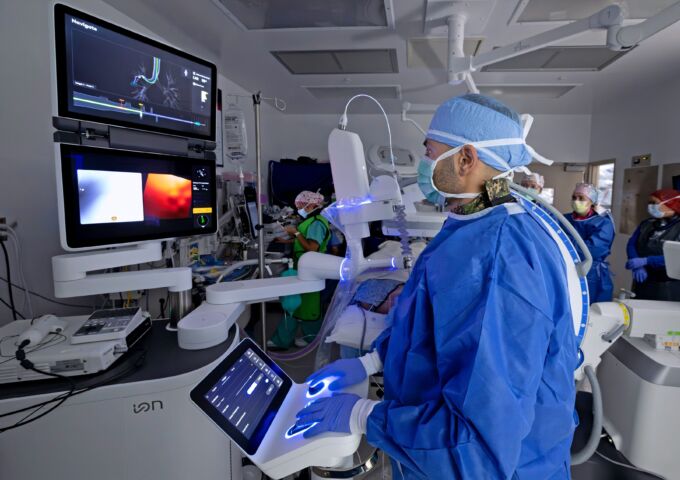
During the roughly 30-minute procedure on June 20, Seims used an endoscope to place an 8mm magnet into the upper pouch of the baby’s esophagus while his wife, USA Health pediatric gastroenterologist Jenelle Fernandez, M.D., placed a second magnet through the gastrostomy site and into the lower pouch. They used X-rays to ensure that the magnets met properly in the middle to hold the two sections of the esophagus together.
“Over the course of a week, the esophageal tissue between the magnets disappears and leaves a connection between the two ends,” Seims explained. “The magnets, stuck together, fall into the stomach, where they can be removed endoscopically through the gastrostomy or allowed to pass through the GI tract.”
The procedure was a success, though Martin has undergone dilations to ensure that his esophagus remains open. Following one of those procedures, on Sept. 19, his mother, Maribel, held her son in the recovery area at Children’s & Women’s Hospital. Awake and alert with a shock of black hair, Martin glanced around as his mother and grandmother talked with hospital staff.
Maribel gestured toward her mother, as she described how she has coped with her baby’s journey. “It’s been good because my mom has been accompanying me in this,” she said. “Thanks to the doctor and to God; they are doing this.”
Seims said the magnet procedure is the first case he and his wife performed together, though they have collaborated on patient care, published, and presented research jointly in the past.
“I genuinely look forward to the continued collaboration that lies ahead,” Fernandez said. “I believe our shared commitment to patient care, mutual respect and open communication will make for a truly rewarding professional journey.”