Senior medical students match into residency programs including USA Health
This year, 36% of Whiddon College of Medicine students matched at programs in Alabama, including 16 students who will continue their training at USA Health hospitals.
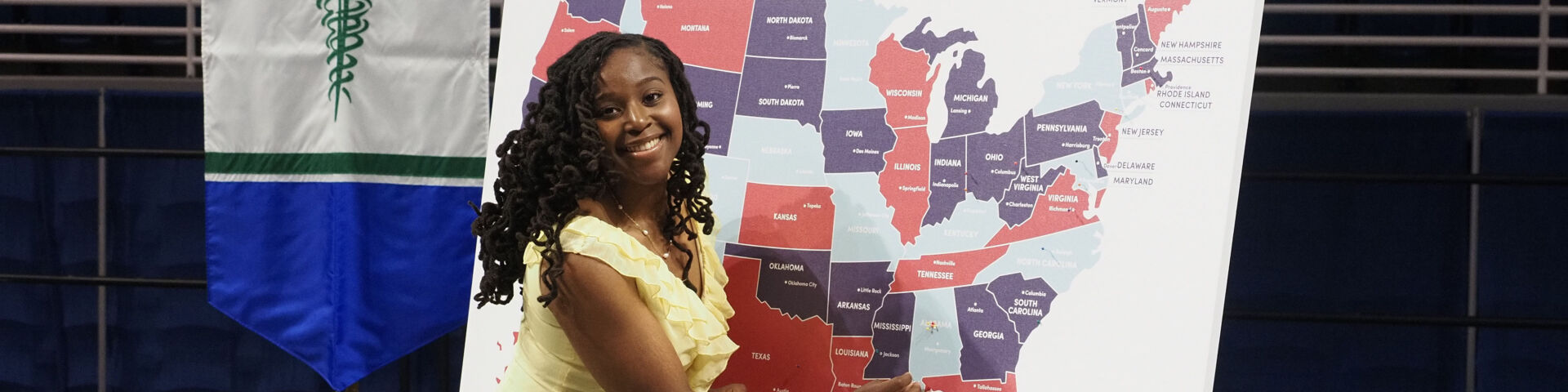
On Friday morning, the USA Mitchell Center buzzed with nervous excitement as 70 members of the Frederick P. Whiddon College of Medicine’s Class of 2026 counted down to one of the most anticipated milestones in medical education. At 11 a.m., students tore open their envelopes, joining medical school seniors across the country in learning where they will spend the next several years training as resident physicians.
This year, 36% of the class matched at programs in Alabama, including 16 students who will continue their training at USA Health hospitals. In addition, 39% of the class matched in primary care specialties.
Held annually on the third Friday of March, Match Day represents years of rigorous training, mentorship and personal growth. It also concludes months of interviews and ranking through the National Resident Matching Program.
“I am excited, anxious, but mostly proud of my wife and I for making it to this point where we have the opportunity to match into our specialties,” said Samuel Motz, who participated in the couples match with his fiancé, Madelyn Campbell. “Madelyn has been my rock throughout this journey through medical school, and I could not have done it without her love and support.”
Campbell and Motz, who began dating before medical school, were accepted to the Whiddon College of Medicine at the same time and will celebrate their wedding just days before they graduate in May with their medical degrees. Both secured residency positions at USA Health.
Campbell, of Coppell, Texas, found her calling in obstetrics and gynecology, a path inspired by her passion for patient advocacy, which took shape during her third-year rotation.
“Coming into medical school, I knew I wanted to pursue a field that allowed me to advocate on behalf of patients facing various injustices,” she said. “I fell in love with how impactful patient advocacy could be on maternal-fetal outcomes.”
Motz, of Huntsville, Alabama, is pursuing general surgery after gaining an appreciation for the specialty’s breadth and complexity during his third-year clinical rotations.
“What draws me most to general surgery is the versatility of the surgeon’s role,” he said. “Ultimately, general surgery feels like the place where I can have the greatest impact on the patients and communities I serve. It is a field that demands lifelong learning, constant growth, and a commitment to excellence, which are qualities that align closely with the kind of physician I hope to become.”
Madison Hogans of Dothan participated in the Whiddon College of Medicine’s Primary Care Pathway, which prepares future physicians to serve rural and underserved communities. Hoping to work in a field that allows her to care for patients throughout their lives, she applied for a combined internal medicine and pediatrics residency.
“I have found that I love caring for patients of all ages and am especially drawn to transitions of care and complex care,” she said. “In the future, I hope to focus on transition and complex care in the outpatient setting while also remaining involved in academic medicine.”
Hogans, who matched at the University of Cincinnati for residency, said she will always be proud to say her journey started at the University of South Alabama.
“Over the past four years, I have had the opportunity to learn from and be mentored by exceptional faculty, and for that I am incredibly grateful,” she said. “Through the robust and diverse experiences they provided, I have grown in my confidence and feel comfortable with whatever situation I may find myself in, whether that be in a teaching role, identifying resources in a primary care or rural setting, or simply providing patient-centered care to my patients.”