September safety behavior: ‘Offer and accept cross checks’
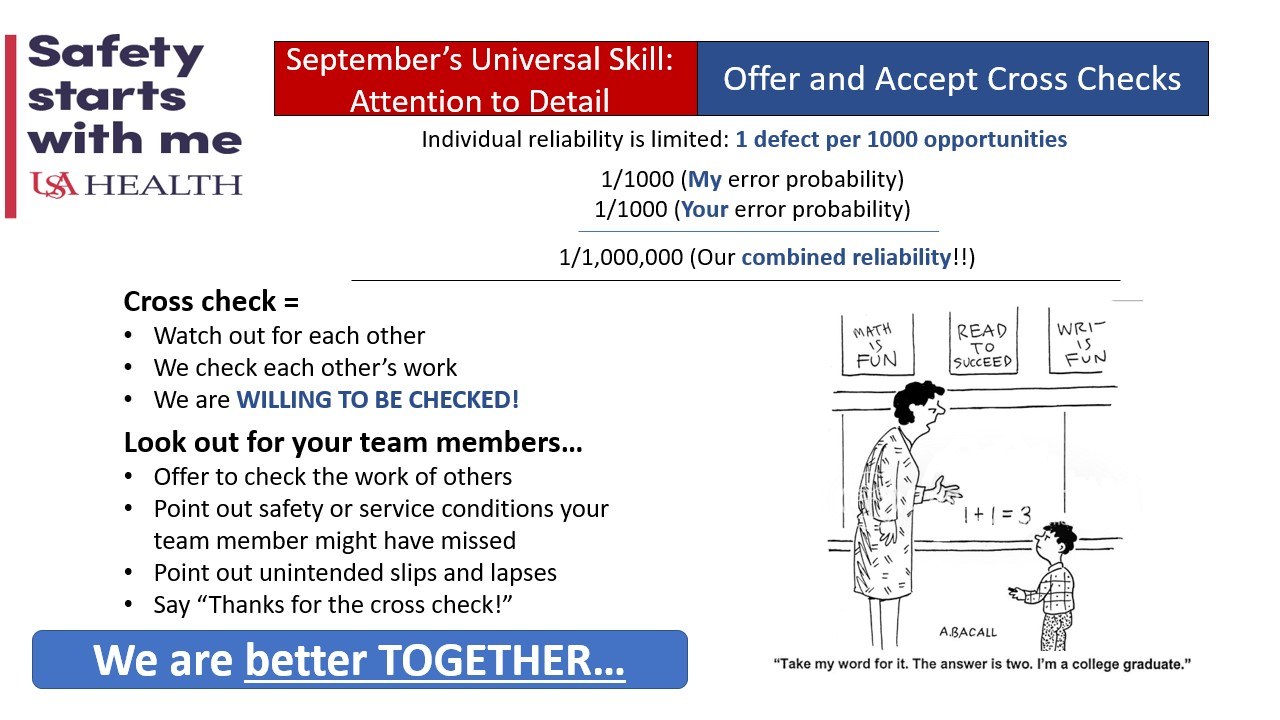
This safety behavior reminds us to watch out for each other, check each other’s work and be willing to be checked.
If you have ever written an email, memo or letter and asked someone to proofread it, you’ll be familiar with this month’s safety behavior: “Offer and accept cross checks.”
“The cross check enables another set of eyes to review our work, allowing someone to identify mistakes we have made so we can fix them,” Becky Pomrenke, MSN, RN, CNL, CNS, patient safety director for USA Health. “In healthcare, this safety behavior reminds us to watch out for each other, check each other’s work and be willing to be checked.”
For every 1,000 actions we take, we make one mistake, according to reliability estimates. This is especially true when the actions are skill-based behaviors, such as tying your shoes or those repetitive tasks that we can “do in our sleep,” Pomrenke said. “We average about 10,000 skill-based behaviors a day, so chances are, we will be making a mistake performing these routine actions.”
The September safety behavior encourages employees to:
- Offer to check the work of others.
- Point out safety or service conditions your team member may have missed.
- Point out unintended slips and lapses.
- Respond to checks by saying, “Thanks for the cross check!”
“Cross checking, or peer checking, is an easy way to help each other perform at our best,” Pomrenke said. “The bottom line is we are better together.”
The safety behavior of the month, part of USA Health’s Safety Starts With Me initiative, is discussed and practiced at huddles and in departments across the health system.