A heartbeat restored: USA Health cardiologist reunites with referee whose life he helped save
Brock Cole's survival after cardiac arrest on a soccer field highlights the lifesaving importance of CPR and early defibrillation.
By Michelle Ryan-Day
[email protected]
For Brock Cole, the sound of a heartbeat carries a meaning he will never take for granted.
On Oct. 11, the 48-year-old soccer referee collapsed in cardiac arrest while officiating a game at Trione Park in Daphne. His heart stopped beating, and his survival depended on the quick actions of several people who jumped in to help.
Among them was Christopher Malozzi, D.O., a cardiologist at USA Health who happened to be at an adjacent soccer field. Malozzi and others rushed to Cole's aid, began cardiopulmonary resuscitation (CPR) and helped get an automated external defibrillator (AED) to him within 24 seconds of his collapse.
Their actions helped give Cole a second chance at life.
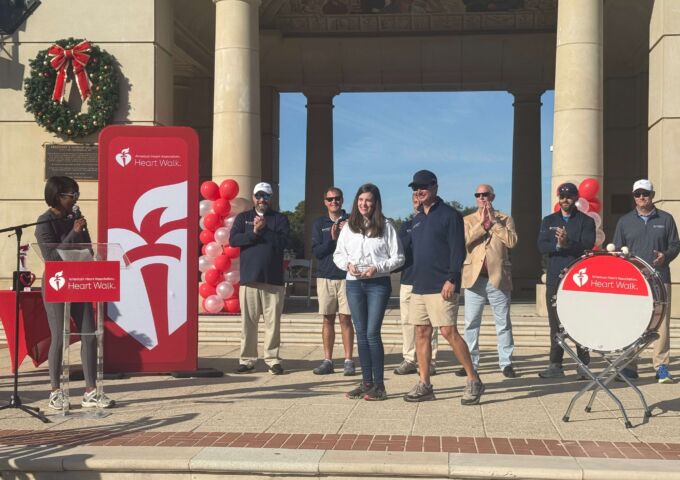
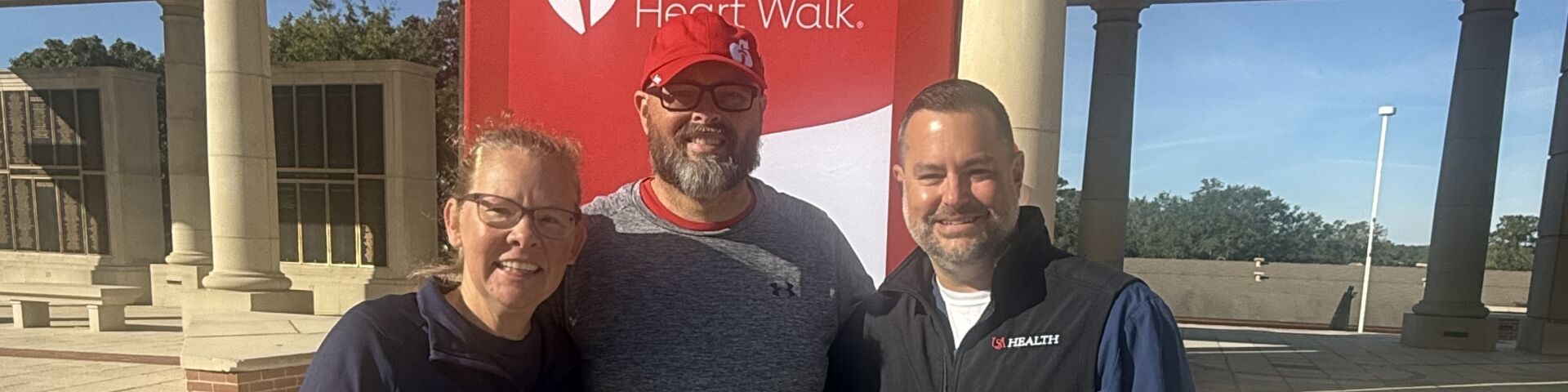
Several weeks later, the two reunited at the American Heart Association's Mobile Heart Walk, where Cole served as the event's honorary heartbeat, beating a drum to symbolize the steady rhythm that was nearly lost.
The reunion was an emotional reminder of how quickly a medical emergency can unfold — and how much a prepared community can accomplish when people know what to do.
"I was one of the lucky ones," Cole said. "I could not have, without the chips falling all in place, having someone like Dr. Malozzi, the first responders, the trainer who was there on the sideline, the fact that an AED was there within 24 seconds of me falling. All those things fell into place for me to be alive right now."
Cole also expressed gratitude to everyone who responded, supported his recovery and prayed for him.
The outcome is particularly remarkable given the statistics surrounding cardiac arrest outside a hospital. According to the American Heart Association, approximately 90% of people who experience an out-of-hospital cardiac arrest do not survive. National data show that only about 10.5% of adults treated by emergency medical services for out-of-hospital cardiac arrest survive until hospital discharge.
Cole's survival underscores the difference that immediate CPR, rapid access to an AED and coordinated emergency response can make.
Malozzi said the circumstances surrounding Cole's collapse demonstrated what can happen when multiple people know how to respond and act without hesitation.
"Everything that happened in that moment was absolutely perfect," Malozzi said. "Everyone knew how to do CPR. Everyone knew where the AED was. Everything was done in time, quickly, and he's standing here today because people stood up and did that."
Cole later learned that he had three blockages and needed a double bypass. He told FOX10 News that he is feeling well and making progress in cardiac rehabilitation.
For Malozzi, the reunion offered an opportunity to turn a life-changing experience into a message for the community: Everyone can learn CPR, and that knowledge could save someone's life.
"Anyone standing here can learn how to do CPR," Malozzi said. "Super easy, but it can save a life. So, I encourage you to do that."
Cole plans to share his experience and encourage others to learn CPR and become familiar with AEDs, hoping to help another family avoid the heartbreak that can accompany sudden cardiac arrest.
"I'm going to take the opportunity and run with it," Cole said. "I'm going to spread awareness and do whatever I can to help raise awareness and save someone else's life. I'm glad I get to return the favor. That's the biggest thing. I want to pay it forward."
The reunion at the Mobile Heart Walk also celebrated the community's commitment to fighting heart disease. The event raised $200,133 overall, with USA Health and the University of South Alabama campus combining to raise $23,005 — the second-highest fundraising total among participating organizations.
USA Health's fundraising efforts related to the Mobile Heart Walk have grown significantly. From 2022 through 2025, the organization raised a collective $11,942.44. This year alone, USA Health raised $15,403.55 between June and the November event, surpassing its combined total from the previous four years. Additional donations were still being collected following the walk.